Sophie Kavanagh wrote about her experience hosting TY school students in our lab for some engaging science outreach as part of Systems Biology Ireland’s blog. The CuriosiTY Programme brought postgraduate researchers from the Conway Institute together to take part and introduce students to the world of STEM, and is supported by SFI Discover funding.
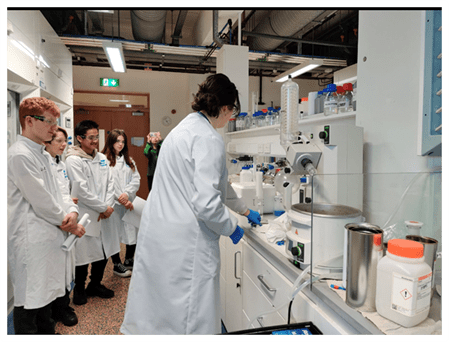
The week kicked off with a researcher showcase, allowing each of us researchers to show our journey in STEM, and our current areas of research. This was followed by some laboratory breakout sessions throughout the week, where I gave 4 small groups of students hands-on experience in the world of chemistry. I decided to centre the lab session around carbon dioxide. The sessions began with observing the interaction of dry ice with warm, soapy water, resulting in a flurry of smoky bubbles, full of carbon dioxide. The extinguishing power of carbon dioxide was demonstrated by placing dry ice in a beaker of water and pouring the dense gas over a lit tea candle, causing it to extinguish, showing some properties of carbon dioxide. Next the concept of respiration was explored, linking respiration and carbon dioxide exhalation. I pre-made some lime water for the students to experiment with. The idea here was to send home the message that even though carbon dioxide gas is a colourless, odourless and tasteless gas, we can detect its presence. Each student was given a beaker of lime water with a straw to blow bubbles and observe the colour change from colourless to milky white, and we all had a competition to see who could get their limewater to change colour the quickest. To wrap up the laboratory session, students engaged in a ‘fire-fighting’ activity. I wanted to show an important use of carbon dioxide, and how to make carbon dioxide balloons at home with some common household items (with adult supervision of course!) Students combined a balloon full of baking soda and a bottle of white vinegar, resulting in a balloon full of carbon dioxide gas. One-by-one, a tea candle was lit and students got to release their carbon dioxide-containing balloons, extinguishing the flames. This hands-on experience allowed students to showcase their inner scientists and left them both excited and knowledgeable. Each session was concluded with a tour of the lab, and a Q&A session where they asked me questions about chemistry, the Leaving Cert, and what a typical day in my life looks like.
Well done to Sophie for taking the initiative of taking part of this project with UCD Conway Institute.
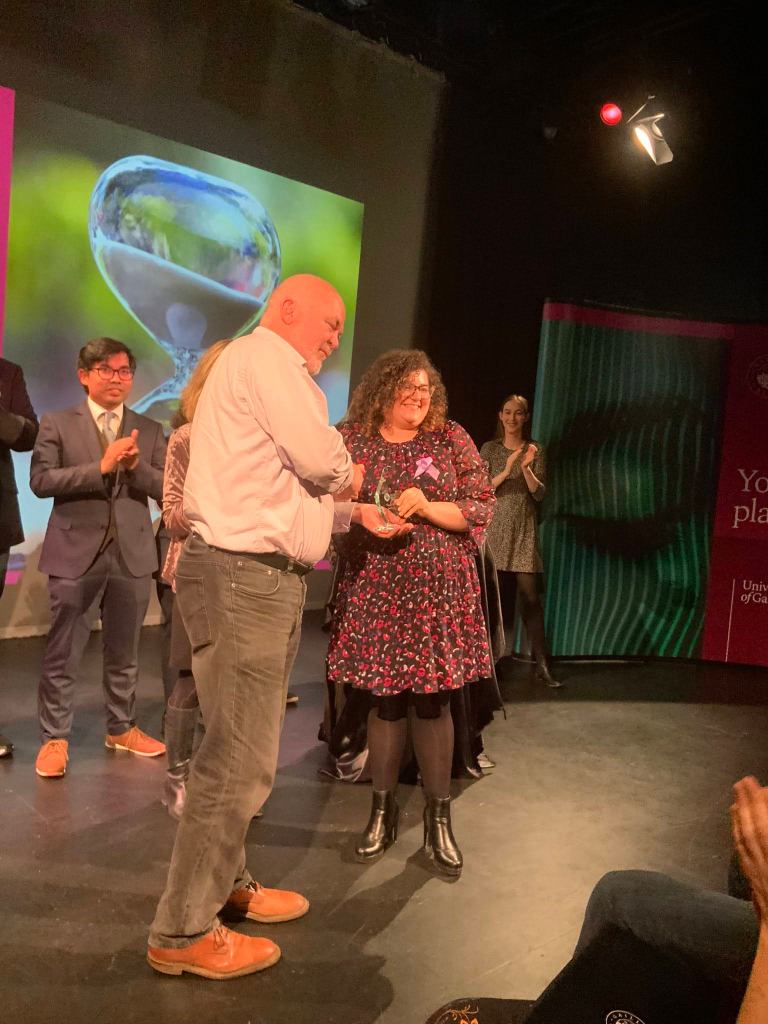
Rosy won second place in the 2022 Threesis Contest, where researchers present their thesis to a lay audience in 3 slides and 3 minutes. Dozens of PhD students from every school in University of Galway competed in this long-running Science Communication challenge this year, including Rosy and Karolina. Rosy’s talk, titled “Tumours play hide and seek; how do we win?” was received very well by the judges and audience and was a well-deserved prize winner. Well done, Rosy. You can watch a video of her contribution below.
Rosy is a PhD student in Luca Ronconi’s group at University of Galway, co-supervised by Joe since 2021. Her research is into lanthanide complexes conjugated to targeting biomolecules. Her research is funded by the Irish Research Council, and previously by a Hardiman Scholarship.
Rosy wins her awardLuca Ronconi, Rosy Polisicchio, Joe ByrneAll the finalists for the 2022 Threesis Contest
In June 2019, CÚRAM SFI Research Centre for Medical Devices invited its researchers to write some poetry in a workshop with Todd Robinson and recite these poems in public at ‘The Dark Horse’ pub in Athlone. This is the work of Team ‘Drug Delivery 1′ and comprises Liam Fitzgerald, Neville Murphy, Marita Dangol, Joseph Byrne, Miriam O’ Duill and Antonio Monterru.
This was a strange departure from normal scientific communication, and I think we learned a lot about how to use language (but I’m not sure the examples in the video were necessarily the best examples of that!)


 Byrne Research Group