Karolina defends her PhD thesis

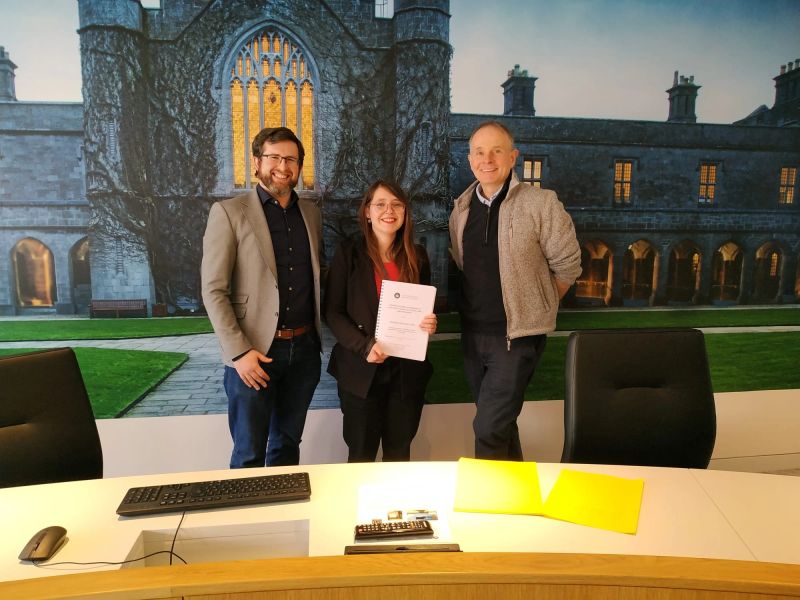
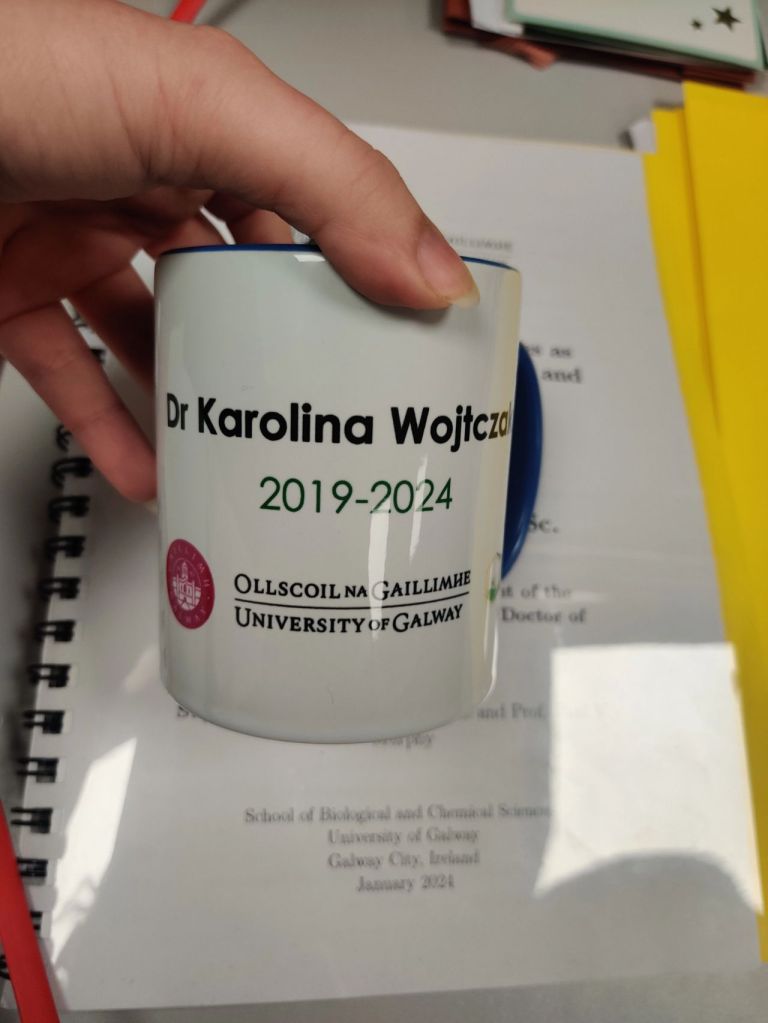
Very proud of my very first PhD student Karolina Wojtczak who successfully defended her thesis last Thursday. A lot of hard work has paid off and she has left the group lots of interesting starting points for future projects (in addition to a few more imminent publications). Her thesis was titled “Metal-based glycoconjugates as molecular sensors for lectins and anti-adhesives”.

Karol was an absolute pleasure to have in my lab and I wish her all the best with her bright future. I’m sure she will achieve great things. Congratulations!

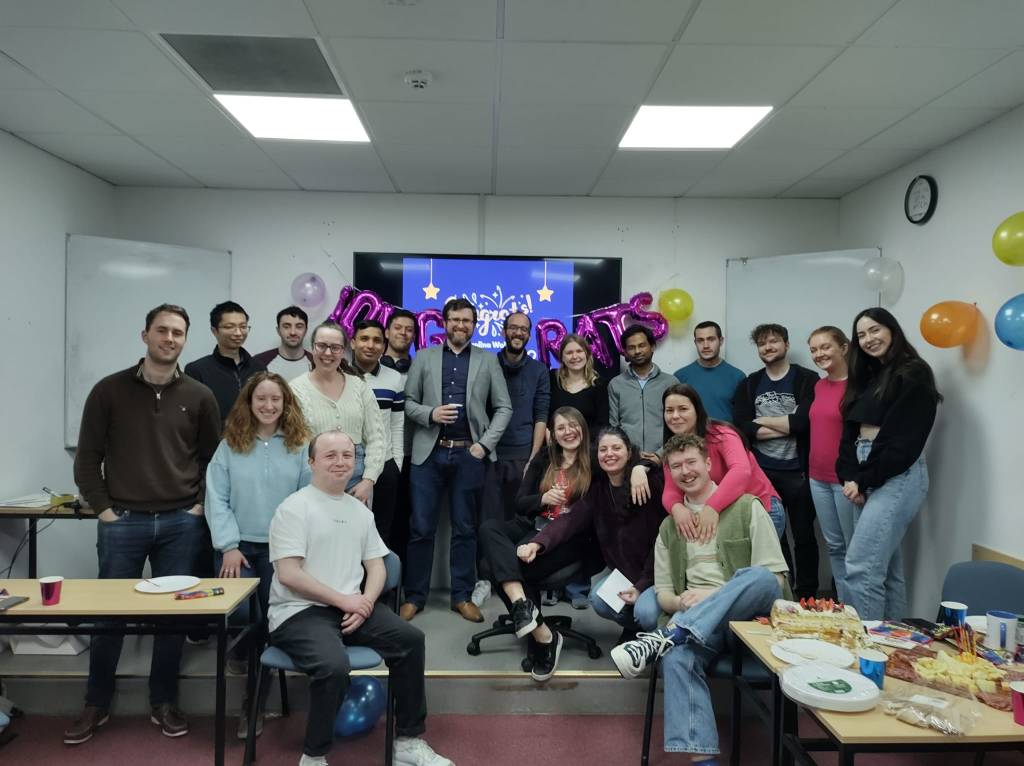
A great celebration was had in Galway to mark the occasion.

Thanks to Research Ireland (formerly SFI) (18/SIRG/5501) for financial support and Paul Murphy for co-supervising her, particularly after I moved to UCD last year.

Karol has already started a position as a Development Chemist in Sterling Pharma Solutions.

ChemComm: Terbium-based lectin sensors

Congratulations to Karolina on her first article published in Chemical Communications. The article has been included in the HOT Articles 2023 Collection as well as a themed collection on Chemosensors and Molecular Logic (related to last year’s MSMLG Conference). The work was considered exciting by the editors and so was featured on the Front Cover of the journal issue.

We describe glycoconjugate terbium(III) complexes, which are able to detect carbohydrate-binding proteins in aqueous buffer solution. When the carbohydrate motif on the complex matches the target of the protein, an enhancement in lanthanide luminescence is observed. The bacterial lectin LecA (from P. aeruginosa) is one of the detected proteins.

Sensing behaviour of complexes Tb.3. See article for full description of results

This work was funded by Science Foundation Ireland (18/SIRG/5501), with support from a 4th year project student, and our collaborators in TU Dublin (Gordon Cooke) and University of Saarland (Alexander Titz, HZI/HIPS). The interdisciplinary work includes synthesis of new sensor molecules, biological assessment and examination of their lectin binding affinity. We believe this work could lead to the development of tools which could use detection of characteristic proteins from pathogens as a means for diagnosis, and hope to follow up on this in future publications.

Joe awarded IRC Laureate Starting Award

Minister Simon Harris recently announced the Irish Research Council’s €24m investment in fundamental research through the Laureate Awards, including a new project, designed by Joe: Link4Lectin – “Mechanically linked molecular strategy for novel antimicrobial agents, pairing bioactive metal complexes with targeting of the carbohydrate-binding proteins of bacteria”. €399,000 have been committed to this project, in which Joe will lead a team of researchers in discovery of new modular antimicrobial tools. This award will allow Joe to establish independence and expand the group as he moves from University of Galway to UCD.

Announcing the awards, Minister Harris said:

“I am delighted to announce the winners of the second round of the Irish Research Council’s Starting and Consolidator Laureate Awards Programme and I congratulate each of the awardees. It is a pleasure to also welcome the Ukrainian researcher who came to Ireland from the war in Ukraine, and who will collaborate on one of the newly funded projects through the IRC’s innovative Ukrainian Researchers Scheme.

These talented researchers will no doubt contribute hugely towards the world-class excellence that is the bedrock of our research system in Ireland, pushing the boundaries of research knowledge and finding new discoveries that deepen our understanding of the world around us, by looking to the past, questioning the present, and unlocking our future potential.”

Also commenting, Dr Louise Callinan, Director of the Irish Research Council, said: 

“The 48 researchers who will receive funding under the Starting and Consolidator Laureate Awards Programme have the potential to make ground-breaking advances in their respective fields and to bolster Ireland’s competitiveness in European research funding.

This is the second round of Laureate funding and many of the first-round awardees will be completing their research next year. It is testament to the success of the programme that three of the first-round awardees have already gone on to receive European Research Council funding, one as part of Ireland’s first ERC Synergy grant worth €10 million.

The winning projects were awarded on the basis solely of excellence, and applications were assessed through a rigorous and independent international peer-review process.

Keep an eye on our Vacancies page for recruitment as part of this award.
Article on lectin-inhibitors published in ChemMedChem

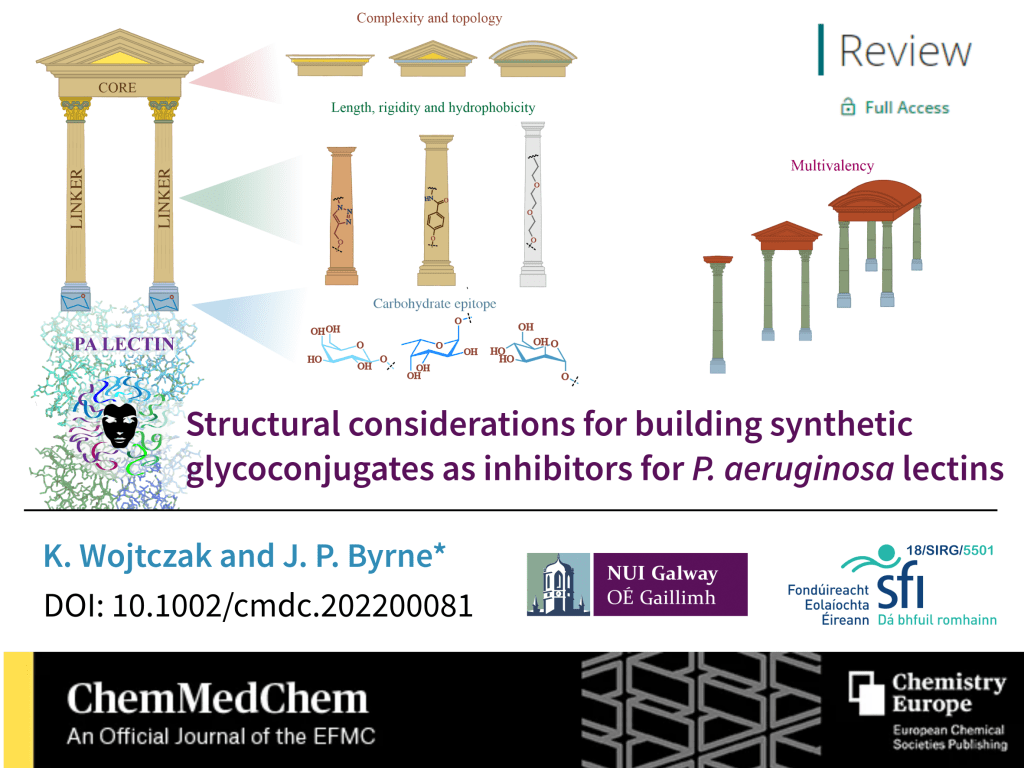
Karolina and Joe’s review article on “Structural considerations for building synthetic glycoconjugates as inhibitors for Pseudomonas aeruginosa lectins” has been published by ChemMedChem. The article is available here: https://doi.org/10.1002/cmdc.202200081

Pseudomonas aeruginosa is a pathogenic bacterium, responsible for a large portion of nosocomial infections globally and designated as critical priority by the World Health Organisation. Its characteristic carbohydrate-binding proteins LecA and LecB, which play a role in biofilm-formation and lung-infection, can be targeted by glycoconjugates. In the review, we present the wide range of inhibitors for these proteins (136 references), highlighting structural features and which impact binding affinity and/or therapeutic effects, including carbohydrate selection; linker length and rigidity; and scaffold topology, particularly for multivalent candidates. We also discuss emerging therapeutic strategies, which build on targeting of LecA and LecB, such as anti-biofilm activity, anti-adhesion and drug-delivery, with promising prospects for medicinal chemistry.

This article would be a good entry-point for any researchers considering tackling P. aeruginosa as a target organism, particularly if they want to build lectin-targeting ligands building on the existing consensus in the field on the best structural features to ensure high lectin affinity.

Thanks to Science Foundation Ireland for funding this research.