Joe is organising an Online Seminar Series in NUI Galway’s School of Chemistry. The programme for this series of lectures is given below, and many of the talks will be open to the public. Links will be shared on the School’s Events page in the days before the lecture. Seminars are hosted on Microsoft Teams group “NUI Galway Chemistry Seminar Series”. With most normal activities in research labs shut down for a period of months due to the Coronavirus Lockdown, and conferences canceled for the summer, these seminars offer us a chance to engage with exciting research from around the world.
The weekly seminars take place on Fridays at 12 noon (Irish time), unless otherwise specified. Contact Joe directly for more details.
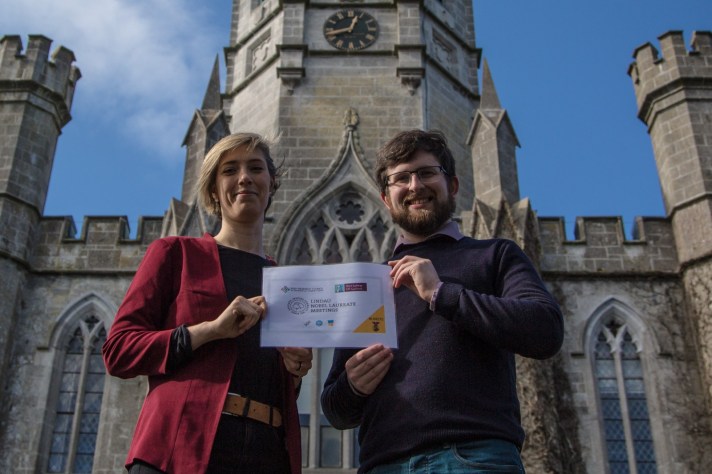
Joe and our colleague Adele Gabba, both from NUI Galway’s School of Chemistry, have been selected to attend the prestigious meeting of Nobel Laureates and emerging scientists from around the world in 2021. The pair will represent Ireland at the 70th Lindau Nobel Laureate Meeting on the island of Lindau in Germany.
From the NUI Galway press release: Dr Byrne and Dr Gabba will join a selected group of 660 outstanding early-career scientists from 101 countries, who will meet with 68 Nobel Prize winners in the fields of chemistry, medicine and physiology, and physics. Selection to attend this week-long meeting offers a once-in-a-career opportunity to share their research and ideas with Nobel laureates and a wide network of future scientific leaders.
Dr Joseph Byrne is an Honorary Research Lecturer in the School of Chemistry, who is in the first year of a Science Foundation Ireland Starting Investigator Research Grant project, developing luminescent glycoconjugate materials for detection of bacterial infections.
Dr Adele Gabba recently graduated with a PhD in Chemistry and currently works as a research assistant in the group of Professor Paul Murphy, School of Chemistry at NUI Galway. She will begin a prestigious Marie Sklodowska-Curie Individual Fellowship in MIT in the coming months.
Dr Gabba and Dr Byrne were among six scientists nominated by the Irish Research Council (IRC), before going through a rigorous international selection process, through which only half of nominees were ultimately invited to attend. They will receive a grant from the Irish Research Council to enable them to attend the meeting, which takes place from 27 June-2 July 2021. The meeting was scheduled for this summer, but due to the outbreak of COVID-19, it has been postponed until 2021, while an interactive online programme of events will take place this year to fulfil the Lindau Foundation’s mission ‘Educate. Inspire. Connect.’
Joe said:
“This meeting is unique in putting the most ground-breaking scientists of recent decades and early-career researchers around the same tables for a week. With little-to-no distraction from the outside world, it is ideal for transferring ideas and sharing challenges between generations and countries as well as different disciplines. I am looking forward to building new relationships with other chemists, but also biochemists, physicists, medical scientists, who I could collaborate with to tackle challenging scientific questions of international relevance in the future.”
Adele said:
Dr Gabba said: “Being selected to attend a Nobel Laureate Meeting is a small life dream come true! I have been certainly looking forward with immense excitement for June, so I have to confess the news of the postponement for COVID-19 came along with a bit of disappointment. Despite my childlike eagerness, I think the organising committee took the right decision. I am sure all attendees will see that waiting and, most of all, the reason behind it, as an opportunity to reflect deeply on the importance of bringing together researchers with a different background in an interdisciplinary meeting. Problems that impact our society are mostly extremely complex, we will succeed in solving them only if we put our brains and best efforts together.”
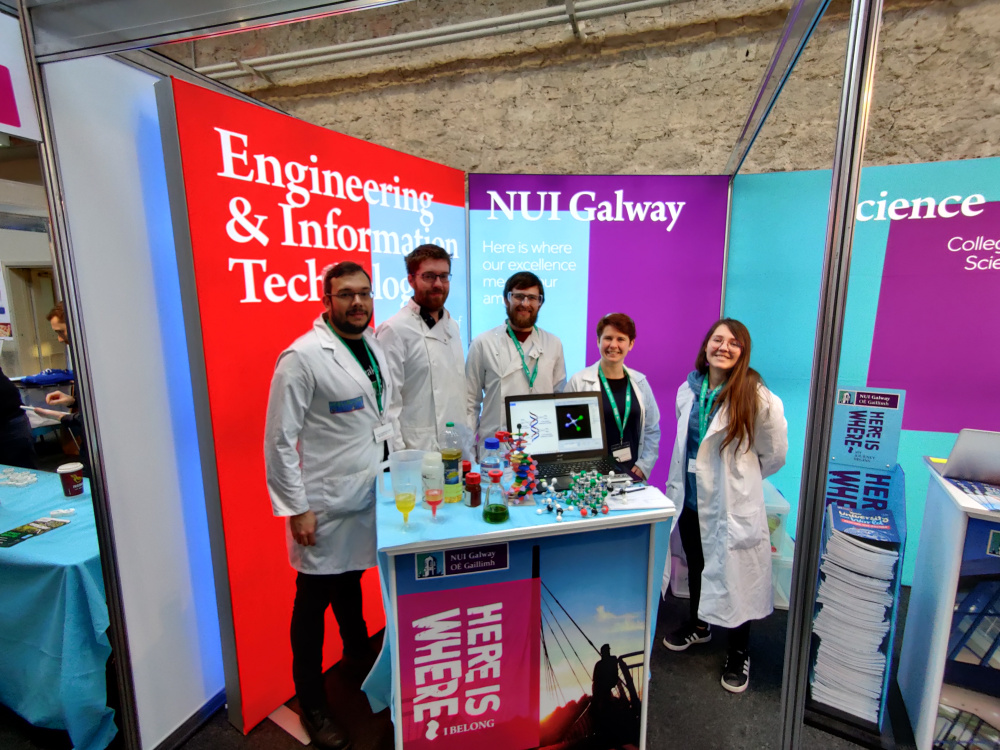
Kitchen Chemistry at BT Young Scientist and Technology Exhibition 2020
Karolina and Joe joined the team from Kitchen Chemistry, who spent a day representing NUI Galway’s College of Science at the BT Young Scientist & Technology Exhibition. It was a long but engaging day of demonstrating simple chemistry experiments to members of the public of all ages, from primary school children up. In particular it was a chance to talk to the many secondary school students who attend this annual event about studying science, and particularly chemistry, at university level.
There were some very high-quality projects on display at the competition, presented by students who had a good understanding of how to carry out a well-designed scientific project. The future is bright.
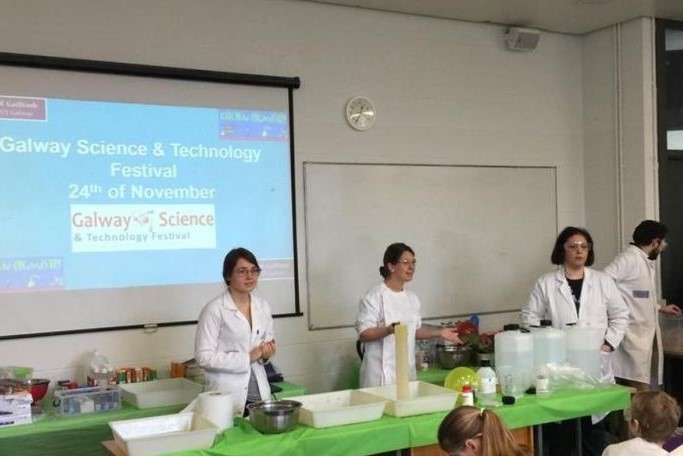
Karolina, Dr O’Duill and Dr Papatriantafyllopoulou at GSTF 2019
As part of Kitchen Chemistry, Karolina took part in a Chemistry Workshop for primary school students as part of the Galway Science and Technology Festival. This festival is part of the national Science Week celebrations.
For the first time in 427 Trinity Alumni met in Galway with the Provost. Lovely to hear about all the significant new developments to TCD's campus and to meet with some new @nuigalway colleagues. https://t.co/7UfELoc10s
— Iósaf Ó Beirne (Dr Joe Byrne 👨🔬🧪) (@anbeirneach) October 23, 2019
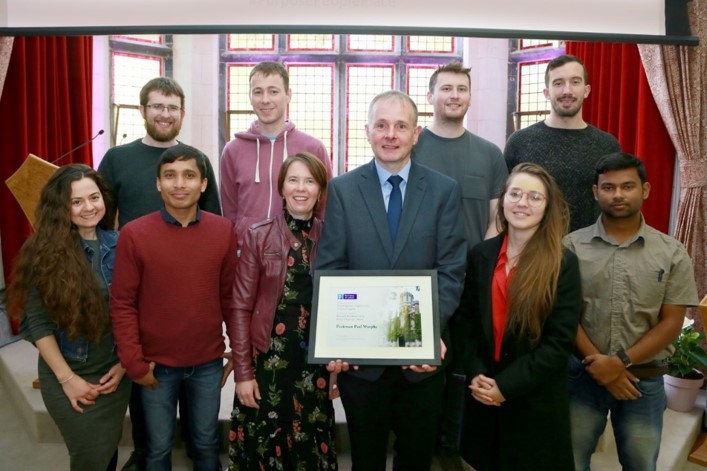
Congratulations to Prof Paul Murphy on his recognition by NUI Galway with a Research Supervision Award, reflecting his commitment to training PhD students and postdocs through the years. Paul is Joe’s SIRG-mentor and co-supervises Karolina’s PhD project. We are very grateful for his support and hosting us in his lab space at NUI Galway. The award is very well deserved!
Prof Paul Murphy along with researchers he currently supervises at the awards ceremony
The Public Session of the Dillon Centenary Symposium is available to view on YouTube. This includes the Dillon Threesis Challenge (young researchers talking about their work for 3 minutes with zero jargon), a chemistry-inspired ballet and historical talk about Prof Dillon.
Selected lectures from the Scientific Session are available as a playlist here.
Not all lectures were broadcast. Consult the programme to see who is currently speaking. The “Public Session” from 17.00 GMT was broadcast.
Update 20/12/2019: More edited videos of the threesis and ballet, filmed from various angles are now available as a playlist here.
In June 2019, CÚRAM SFI Research Centre for Medical Devices invited its researchers to write some poetry in a workshop with Todd Robinson and recite these poems in public at ‘The Dark Horse’ pub in Athlone. This is the work of Team ‘Drug Delivery 1′ and comprises Liam Fitzgerald, Neville Murphy, Marita Dangol, Joseph Byrne, Miriam O’ Duill and Antonio Monterru.
This was a strange departure from normal scientific communication, and I think we learned a lot about how to use language (but I’m not sure the examples in the video were necessarily the best examples of that!)
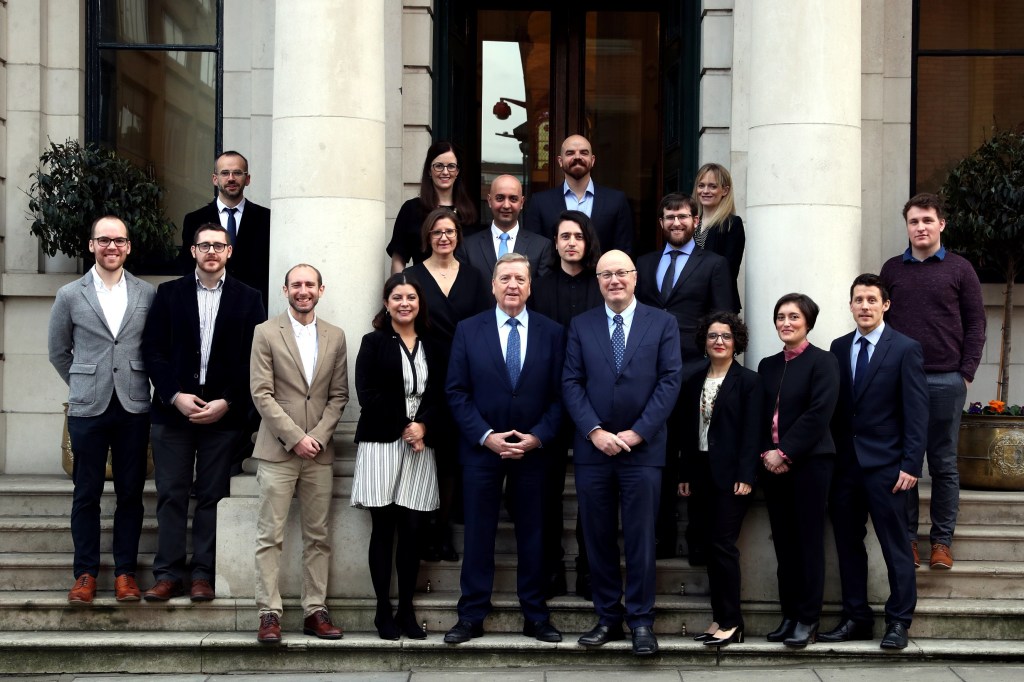
Joe, pictured with James Lawless TD (Fianna Fáil Science and Technology Spokesperson) and Minister Pat Breen TD (Minister of State with special responsibility for Trade, Employment, Business, EU Digital Single Market and Data Protection) outside the Irish Parliament
Joe was awarded a Starting Investigator Research Grant (SIRG) by Science Foundation Ireland at a ceremony today with Minister Pat Breen. This SIRG award will allow him to begin a programme of independent research in NUI Galway in the coming months and begin to build his own research group.
The new research will develop novel devices that will indicate the presence of specific bacteria through colour changes (modulating luminescence), using interactions of their proteins with sugar-based chemical compounds on the surface of newly-designed materials. This will provide a convenient visual strategy to identify disease-causing bacteria. 3D-Printing will be used to create these compact diagnostic devices, which will benefit patient outcomes and quality of life.
“it’s about launching the careers of very bright, young scientists in Ireland”, and indeed it’s a very important programme to allow people like me to return home and start independent research.
Speaking about the planned research, Joe said:
I got interested in fluorescent sensor materials and the chemistry of sugars during my PhD research in Trinity College Dublin with Prof Gunnlaugsson (Irish Research Council Scholarship, 2010-15). Over the last few years in University of Bern, Switzerland, I have been further exploring the role of sugars in catalysis as part of my Marie Curie Fellowship with Prof Albrecht (European Commission H2020, 2017-19). I also gained experience in studying sugar-protein interactions in University of Nottingham, during a 3-month placement there. These interactions are very relevant to a lot of diseases. My new project aims to bring together the skills I have learned through my research training to address practical problems that affect people’s’ lives.
Repro Free: Dublin, 15th January 2019 – Minister for Trade, Employment, Business, EU Digital Single Market and Data Protection, Pat Breen, T.D., today launched Science Foundation Ireland’s Plan for 2019 and announced a research investment of €10.8 million in funding for 20 projects in the areas of health, energy, environment, materials and technology. He is pictured with Prof Mark Ferguson, Director General of Science Foundation Ireland and SFI Starting Investigator Research Grant (SIRG) Awardees. The projects, which will be funded for four years, will support 20 researchers and a further 20 PhD students. (Picture Jason Clarke)
By providing a new methodology for rapid diagnosis of bacterial infection, this work will facilitate quicker decision-making on targeted medical treatment strategies for patients. In Ireland this would be particularly valuable for rapid diagnosis of Pseudomonas aeruginosa infections, a significant risk factor for cystic fibrosis patients (as well as others with compromised immune systems). More generally, helping clinicians avoid the use of broad-spectrum antibiotics would help combat the global challenge of increased antibiotic resistance. This new technology could also be deployed in other scenarios such as detecting bacterial contamination of water supplies.
This award allows me to return to Ireland and make a contribution to Irish society through scientific research, building upon my experience abroad (in Switzerland and the UK). The Starting Investigator Research Grant scheme has given me a fantastic opportunity to begin my independent research programme at a relatively young age in NUI Galway School of Chemistry, and also to work closely with the CÚRAM SFI Centre for Medical Device Research, a hub of expertise in this sector.
The grant also funds recruitment of a PhD student to be part of this interdisciplinary research programme. Interested parties are welcome to get in touch: Contact Joe.

 Byrne Research Group