Catherine completes RISE internship

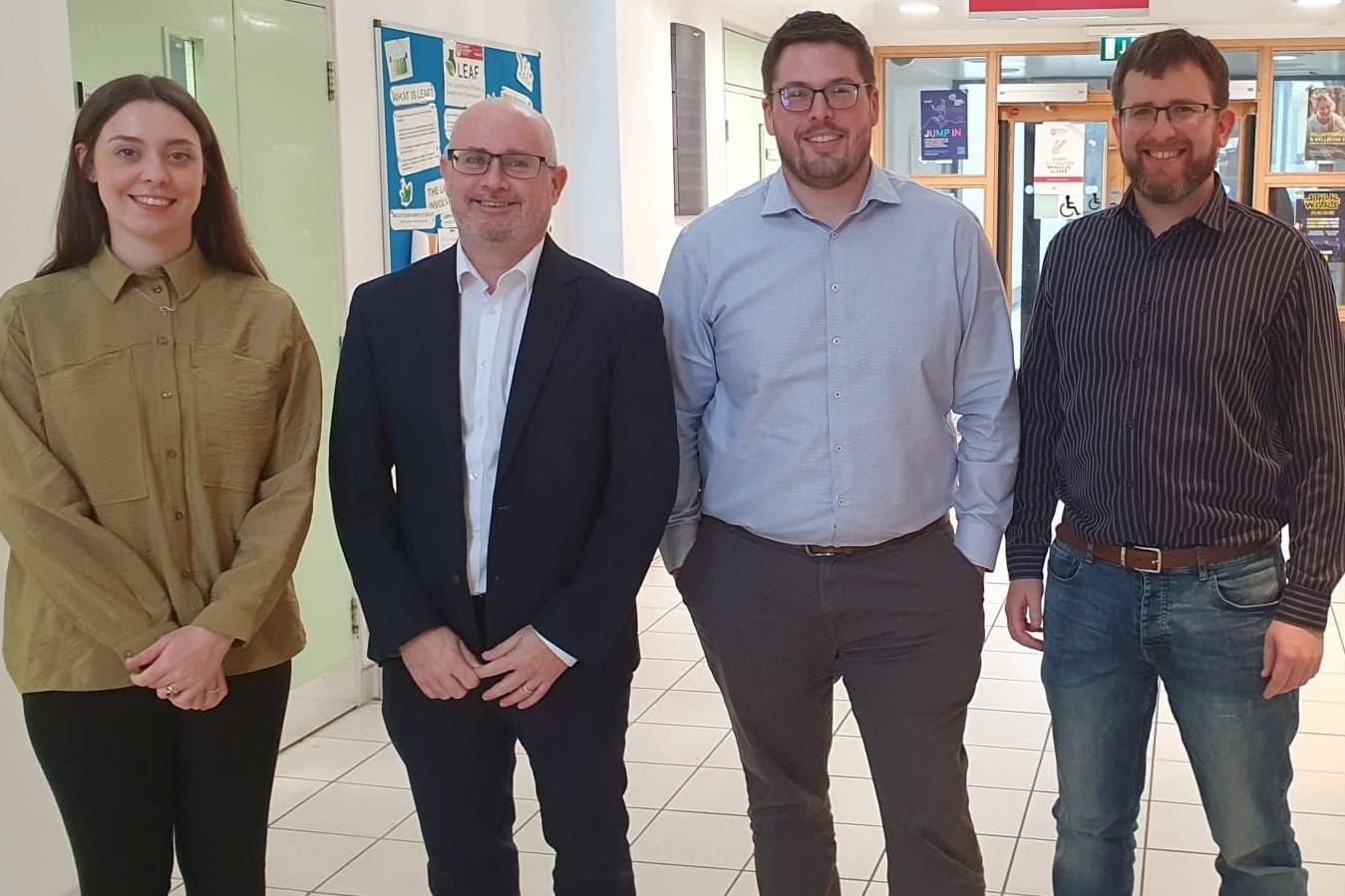
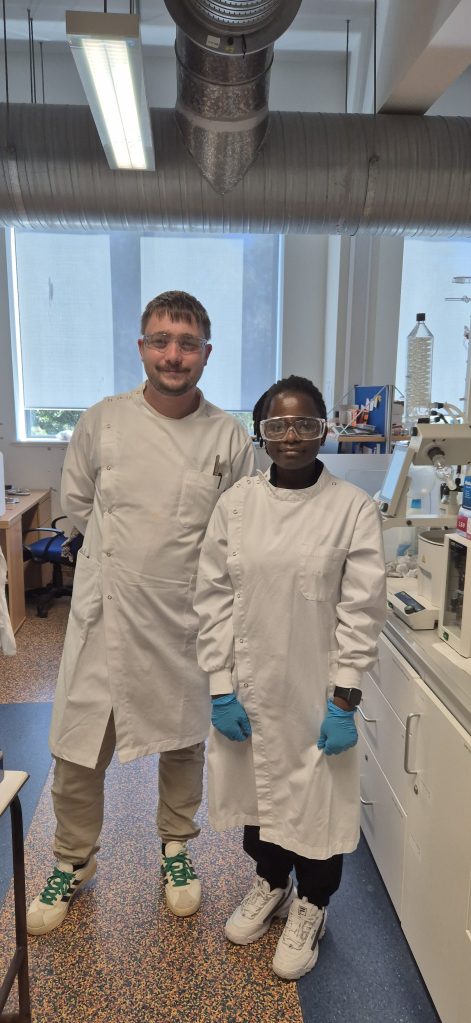
Catherine Chaita, a third-year Pharmaceutical Science students from TU Dublin in Tallaght, joined the lab for two-weeks this summer as part of the RSC RISE Programme, designed to retain, inspire, support, and enhance ethnically-underrepresented groups in the chemical sciences. Catherine had a placement at TU Dublin last summer and came to us this summer. She fit in really well and quickly picked up a lot of skills under Thomas’ tutelage (and contributed to the Link4Lectin project). Catherine had the following to say about her experience:

In the second year [of the RISE programme], I was offered a two-week summer internship at University College Dublin (UCD), where I had the opportunity to work in the laboratory of Professor Joe Byrne, whose research focuses on sugars and inorganic/organic chemistry.
During the internship, I worked under the mentorship of PhD graduate Thomas Rabbitte who guided me through a variety of hands-on experiments. I was actively involved in various research projects. This experience greatly enhanced my technical and analytical skills, as I was introduced to a range of instruments and laboratory techniques relevant to pharmaceutical science. I carried out several chemical reactions, including alkylation, click chemistry, and amide coupling reactions.
The lab environment was collaborative and inspiring, with a team of postgraduate researchers and undergraduate interns all contributing to ongoing sugar-related research. My time at UCD provided me with a solid foundation of practical skills and deeper insight into real-world pharmaceutical and chemical research, and it further fueled my interest in pursuing a career in the pharmaceutical industry.

We wish Catherine every success with the rest of her studies and her future career in chemistry and hope to see her again.

New publication: Metallodrugs in OBC

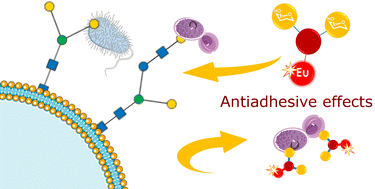
𝗠𝗲𝘁𝗮𝗹 𝗰𝗼𝗺𝗽𝗹𝗲𝘅𝗮𝘁𝗶𝗼𝗻 𝗰𝗮𝗻 𝗺𝗼𝗱𝘂𝗹𝗮𝘁𝗲 𝘁𝗵𝗲 𝗯𝗶𝗼𝗹𝗼𝗴𝗶𝗰𝗮𝗹 𝗮𝗰𝘁𝗶𝘃𝗶𝘁𝘆 𝗼𝗳 𝗴𝗹𝘆𝗰𝗼𝗰𝗼𝗻𝗷𝘂𝗴𝗮𝘁𝗲 𝗹𝗶𝗴𝗮𝗻𝗱𝘀 𝗮𝗴𝗮𝗶𝗻𝘀𝘁 𝗽𝗮𝘁𝗵𝗼𝗴𝗲𝗻𝘀!
Delighted to have another article on glyco-metal complexes published in 𝘖𝘳𝘨𝘢𝘯𝘪𝘤 & 𝘉𝘪𝘰𝘮𝘰𝘭𝘦𝘤𝘶𝘭𝘢𝘳 𝘊𝘩𝘦𝘮𝘪𝘴𝘵𝘳𝘺. This work was led by Karolina Wojtczak, PhD and involved contributions and support from lots of colleagues across disciplines including the teams of Trinidad Velasco-Torrijos, Anne Imberty, Gordon Cooke (TUD), Dr. Cristina Trujillo and Kevin Kavanagh who put lots of work into ideas, assays, measurements and calculations to support our hypotheses.

Please read the full article in the RSC journal Organic and Biomolecular Chemistry, where it will be part of the 2025 New Talent Special Issue: https://doi.org/10.1039/D5OB00970G

Buíochas le Taighde Éireann Research Ireland as ucht tacaíocht.

ChemComm: Terbium-based lectin sensors

Congratulations to Karolina on her first article published in Chemical Communications. The article has been included in the HOT Articles 2023 Collection as well as a themed collection on Chemosensors and Molecular Logic (related to last year’s MSMLG Conference). The work was considered exciting by the editors and so was featured on the Front Cover of the journal issue.

We describe glycoconjugate terbium(III) complexes, which are able to detect carbohydrate-binding proteins in aqueous buffer solution. When the carbohydrate motif on the complex matches the target of the protein, an enhancement in lanthanide luminescence is observed. The bacterial lectin LecA (from P. aeruginosa) is one of the detected proteins.

Sensing behaviour of complexes Tb.3. See article for full description of results

This work was funded by Science Foundation Ireland (18/SIRG/5501), with support from a 4th year project student, and our collaborators in TU Dublin (Gordon Cooke) and University of Saarland (Alexander Titz, HZI/HIPS). The interdisciplinary work includes synthesis of new sensor molecules, biological assessment and examination of their lectin binding affinity. We believe this work could lead to the development of tools which could use detection of characteristic proteins from pathogens as a means for diagnosis, and hope to follow up on this in future publications.

RSC Carbohydrate Meeting in Belfast and first SugarCoat Team Meeting

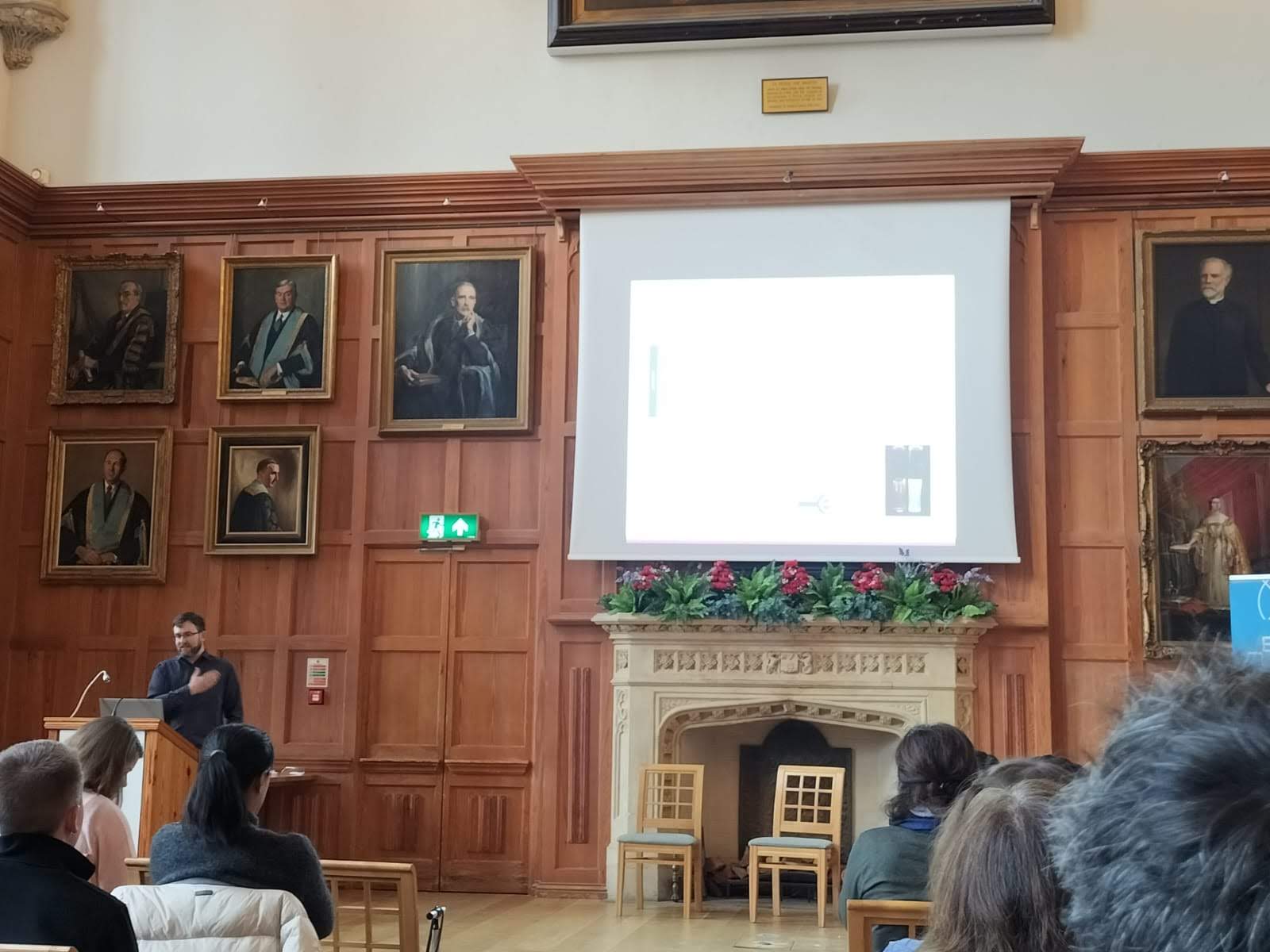
Members of the team attended the RSC Carbohydrate Interest Group Annual Meeting at Queens University Belfast. Joe gave an oral presentation in the Great Hall. There were many interesting international speakers including Alexander Titz and Ulf Nilssen, as well as contributors from the UK and Ireland. The event was co-sponsored by the Institute of Chemistry of Ireland also (Division on Medicinal Chemistry), making it an excellent all-island event. Thanks to Gerd Wagner and Aisling Ní Cheallaigh, among others, for organising.

This meeting also gave an opportunity for the first in-person meeting of the full team of the SugarCoat North South Research Programme project – funded by the Shared Island Fund and the HEA. Postdoc Dr Hannah Crory has been working in the Wylie/McCoy lab in the School of Pharmacy, QUB.

Joe speaks at festive RSC Coordination and Organometallic Discussion Group Christmas Meeting

At the annual RSC Coordination and Organometallic Discussion Group Christmas meeting (UCD Dublin), everyone was asked to select an element as the focus of their talk, to celebrate the end of the International Year of the Periodic Table. Joe gave a talk celebrating the versatility of ruthenium complexes. The talk brought together two different project, linked by this transition metal.

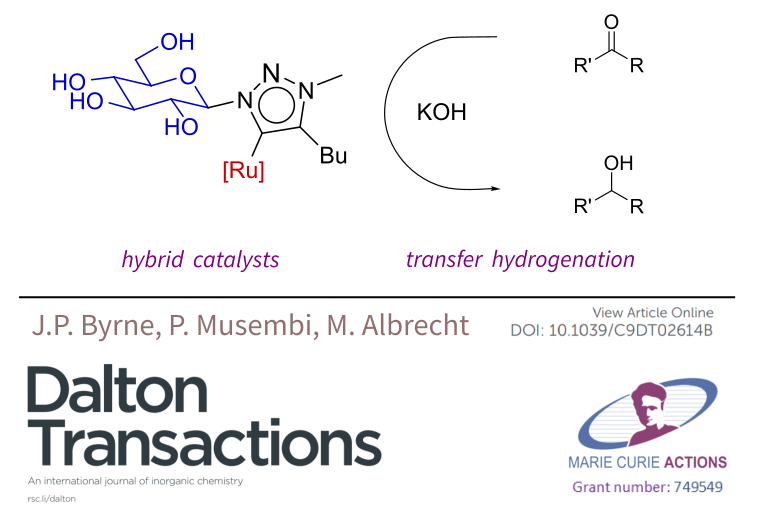
He spoke about the carbohydrate-functionalised Ru-NHC catalysts which were published recently in Dalton Transactions, as well as some Ru(II) coordination complexes (also featuring carbohydrates) which have shown antimicrobial activity (unpublished results, collaboration with Prof Thorri Gunnlaugsson and Dr Ciaran O’Reilly).

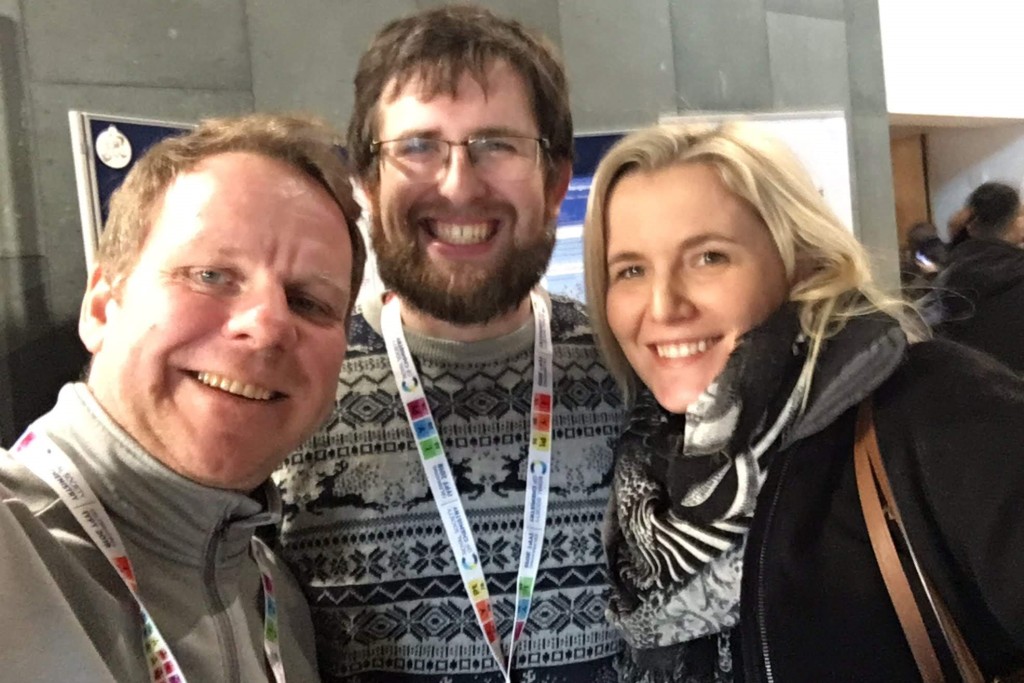
It was a very festive meeting, with inorganic chemists from all over Ireland and the UK in attendance – a great chance to catch up with old friends and new.

New publication in Dalton Transactions

I’m delighted to finally publish this work, the first of my research carried out during my Marie Curie Fellowship in University of Bern to come out. A lot of hard work by Erasmus student Pauline went into gathering data behind this manuscript where we asked the question – what impact would incorporating carbohydrates into the structure of a Ruthenium(II)-triazolylidene complex have on its ability to convert a ketone to an alcohol via transfer hydrogenation catalysis.

There were challenges in isolating the desired compound, so it had to be generated in situ, but we were able to assess the activity, and the results were interesting, and can be found in detail here in Dalton Transactions.

To summarise the conclusions: The carbohydrate functionality does impact catalytic activity (transfer hydrogenation of ketones). In complexes with the glucose directly triazolylidene-bound,  turnover rates were substantially higher when compared to more remote carbohydrate functionalisation (i.e. with an ethylene spacer). Both new complexes, however, have reduced activity compared to  unfunctionalised carbene complexes. Insight was also gained into the nature of the catalytic cycle through a substrate scope analysis.