New article in RSC Advances: Glycoclusters with anti-biofilm activity

Our new article, published in RSC Advances (a Gold Open Access journal), describes a series of new ruthenium-centred glycoclusters, which present four carbohydrate motifs around a three-dimensional octahedral scaffold. Multivalent glycoclusters have previously shown the ability to inhibit the carbohydrate-binding proteins which are produced by bacterium P. aeruginosa. Gordon Cooke’s group in TU Dublin tested these new compounds for their ability to inhibit growth of biofilm by P. aeruginosa and we observed that complex 8Gal, with flexible arms between the scaffold core and the galactose motif gave up to 80% inhibition of biofilm, when compared to the control – the other complexes and the ligand did not show antimicrobial activity. We propose that this activity is due to the ability of galactose to interact with the carbohydrate-binding protein LecA.

We thank Science Foundation Ireland for financial support for this work, as well as UCD School of Medicine’s SSRA Scheme, where preliminary studies began.
Swiss Chemical Society Fall Meeting

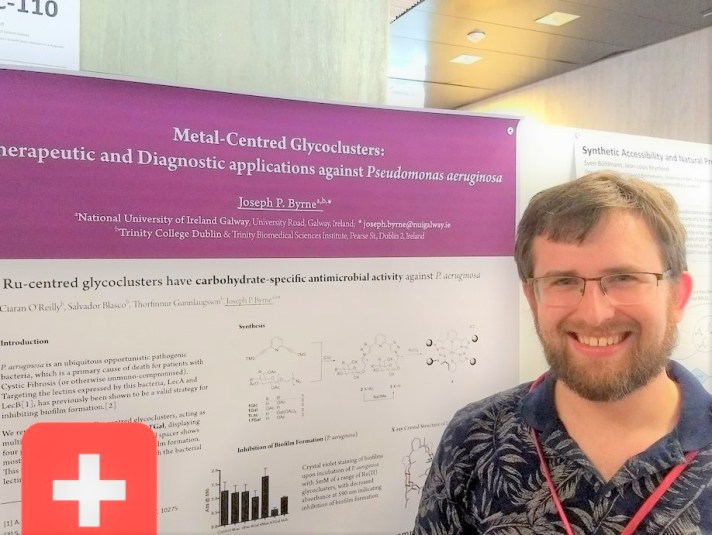
Joe presented a poster at the SCS Fall Meeting in Zurich. The poster described recent work involving metal-centred glycoclusters, tageting carbohydrate-lectin interactions. It was a good opportunity to stay connected with Swiss colleagues from his postdoctoral work in University of Bern, as well as present new research in an international setting.

Afterwards, Joe had some meetings in University of Bern before returning to Galway.

New publication in Dalton Transactions

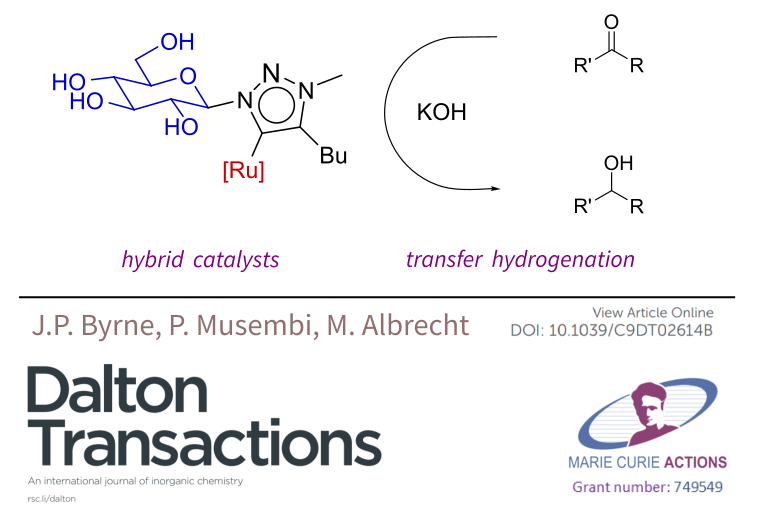
I’m delighted to finally publish this work, the first of my research carried out during my Marie Curie Fellowship in University of Bern to come out. A lot of hard work by Erasmus student Pauline went into gathering data behind this manuscript where we asked the question – what impact would incorporating carbohydrates into the structure of a Ruthenium(II)-triazolylidene complex have on its ability to convert a ketone to an alcohol via transfer hydrogenation catalysis.

There were challenges in isolating the desired compound, so it had to be generated in situ, but we were able to assess the activity, and the results were interesting, and can be found in detail here in Dalton Transactions.

To summarise the conclusions: The carbohydrate functionality does impact catalytic activity (transfer hydrogenation of ketones). In complexes with the glucose directly triazolylidene-bound,  turnover rates were substantially higher when compared to more remote carbohydrate functionalisation (i.e. with an ethylene spacer). Both new complexes, however, have reduced activity compared to  unfunctionalised carbene complexes. Insight was also gained into the nature of the catalytic cycle through a substrate scope analysis.