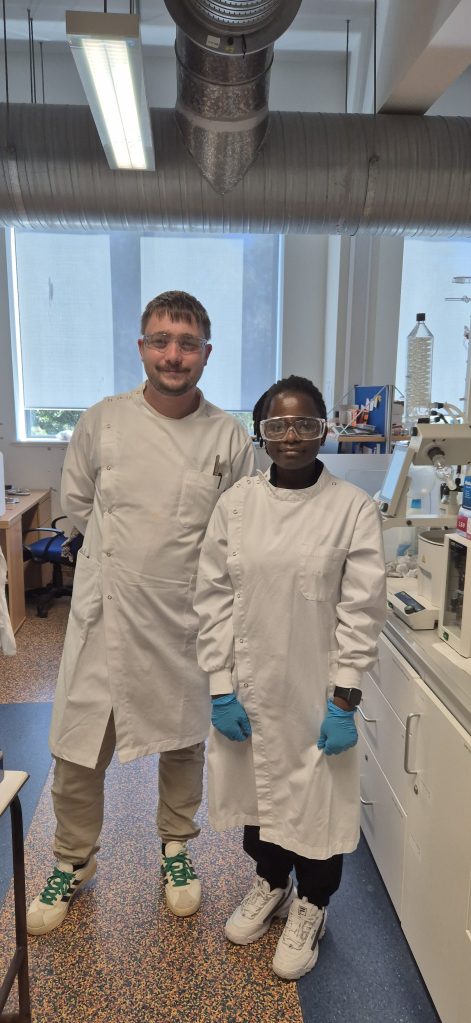
Catherine Chaita, a third-year Pharmaceutical Science students from TU Dublin in Tallaght, joined the lab for two-weeks this summer as part of the RSC RISE Programme, designed to retain, inspire, support, and enhance ethnically-underrepresented groups in the chemical sciences. Catherine had a placement at TU Dublin last summer and came to us this summer. She fit in really well and quickly picked up a lot of skills under Thomas’ tutelage (and contributed to the Link4Lectin project). Catherine had the following to say about her experience:
In the second year [of the RISE programme], I was offered a two-week summer internship at University College Dublin (UCD), where I had the opportunity to work in the laboratory of Professor Joe Byrne, whose research focuses on sugars and inorganic/organic chemistry.
During the internship, I worked under the mentorship of PhD graduate Thomas Rabbitte who guided me through a variety of hands-on experiments. I was actively involved in various research projects. This experience greatly enhanced my technical and analytical skills, as I was introduced to a range of instruments and laboratory techniques relevant to pharmaceutical science. I carried out several chemical reactions, including alkylation, click chemistry, and amide coupling reactions.
The lab environment was collaborative and inspiring, with a team of postgraduate researchers and undergraduate interns all contributing to ongoing sugar-related research. My time at UCD provided me with a solid foundation of practical skills and deeper insight into real-world pharmaceutical and chemical research, and it further fueled my interest in pursuing a career in the pharmaceutical industry.
We wish Catherine every success with the rest of her studies and her future career in chemistry and hope to see her again.


 Byrne Research Group