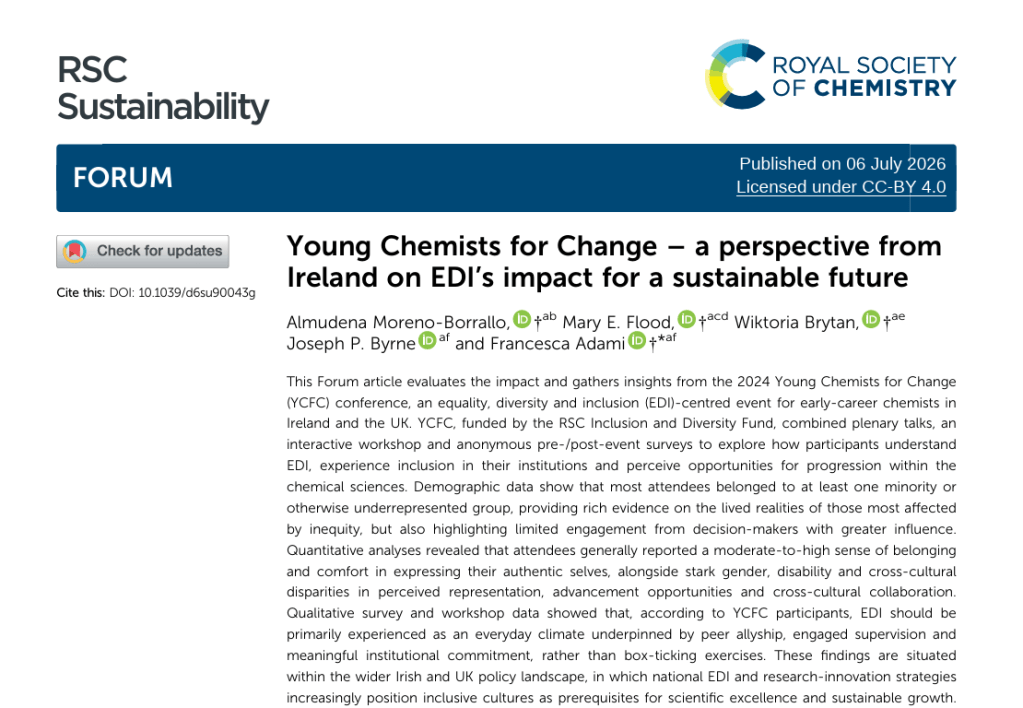
In 2024, the ICI Young Chemists Network (to whom Joe is an Advisor) organised the Young Chemists for Change event at UCD, focussing on the role of equality, diversity and inclusion in the chemistry community in Ireland, the UK and further afield. A full report of the event is available in Irish Chemical Events. This event was supported by the RSC Inclusion and Diversity Fund. Recently a Forum Article about the event was published in RSC Sustainability.
The editor of the journal RSC Sustainability commissioned a collection of Forum articles highlighting impacts of the Inclusion and Diversity Fund, highlighting the relevance of culture in the chemistry community to sustainability more broadly:
“As a journal from the Royal Society of Chemistry, it is to be expected that most authors select one or more of the more obviously technical SDGs. However, it is vital that we remember the importance of societal changes to achieve the SDGs. These are made explicit in SDGs 5 (Gender Equality) and 10 (Reduced Inequalities), but we should also remember that there are other SDGs that have both technical and societal aspects. For example, it will be impossible to deliver SDG 3 (Good Health and Well-Being) without accounting for unequal health outcomes based on sex and gender, race and ethnicity, poverty, geography, prior disability, and sexual orientation. I have always believed that the Chemical Sciences and Chemical Scientists can contribute to all of the SDGs and that RSC Sustainability should play its part in this.”
The Forum article presents demographic data, qualitative and quantitative analysis of responses from attendees at the event, and the impact EDI events can have on awareness and sense of belonging. Joe is a co-author of this article along with the main organisers of the event. The forum article can be read at https://doi.org/10.1039/d6su90043g
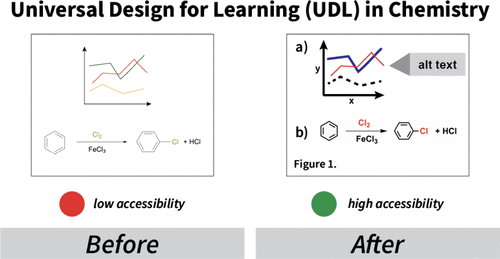
We have a new article in the Journal of Chemical Education! A challenge promoting Universal Design for Learning among chemistry colleagues is that case studies and examples of implementation mostly come from humanities or other fields; direct application can be harder to see. We have put together UDL guides and templates for a chemistry audience, which we hope will make using this powerful framework itself more accessible and relevant to our discipline.
Some highlights include:
Step-by-step guide on upgrading chemistry lecture notes to be more accessible (format, structure, use of colour)
Discussion of a range of accessibility-checkers and tools
Case study of changes made for a set of organic chemistry notes to score 100% on Ally accessibility-checker
Workflow for developing high-quality alt-text for chemistry teaching with aid of AI tools
Insights from staff interviews during a recent rollout of UDL Digital Badge training
Thanks to UCD Access and Lifelong Learning (ALL) for support and feedback in this project, and all the other co-authors, particularly Fun Man Fung for directing our various different efforts towards this manuscript (educational technology, different sub-fields of chemistry and T&L culture discussions). More to come in the future!
𝗠𝗲𝘁𝗮𝗹 𝗰𝗼𝗺𝗽𝗹𝗲𝘅𝗮𝘁𝗶𝗼𝗻 𝗰𝗮𝗻 𝗺𝗼𝗱𝘂𝗹𝗮𝘁𝗲 𝘁𝗵𝗲 𝗯𝗶𝗼𝗹𝗼𝗴𝗶𝗰𝗮𝗹 𝗮𝗰𝘁𝗶𝘃𝗶𝘁𝘆 𝗼𝗳 𝗴𝗹𝘆𝗰𝗼𝗰𝗼𝗻𝗷𝘂𝗴𝗮𝘁𝗲 𝗹𝗶𝗴𝗮𝗻𝗱𝘀 𝗮𝗴𝗮𝗶𝗻𝘀𝘁 𝗽𝗮𝘁𝗵𝗼𝗴𝗲𝗻𝘀! Delighted to have another article on glyco-metal complexes published in 𝘖𝘳𝘨𝘢𝘯𝘪𝘤 & 𝘉𝘪𝘰𝘮𝘰𝘭𝘦𝘤𝘶𝘭𝘢𝘳 𝘊𝘩𝘦𝘮𝘪𝘴𝘵𝘳𝘺. This work was led by Karolina Wojtczak, PhD and involved contributions and support from lots of colleagues across disciplines including the teams of Trinidad Velasco-Torrijos, Anne Imberty, Gordon Cooke (TUD), Dr. Cristina Trujillo and Kevin Kavanagh who put lots of work into ideas, assays, measurements and calculations to support our hypotheses.
Please read the full article in the RSC journal Organic and Biomolecular Chemistry, where it will be part of the 2025 New Talent Special Issue: https://doi.org/10.1039/D5OB00970G
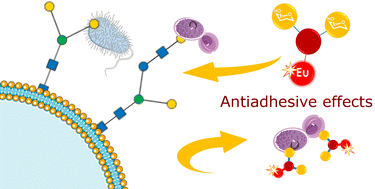
We describe glycoconjugate terbium(III) complexes, which are able to detect carbohydrate-binding proteins in aqueous buffer solution. When the carbohydrate motif on the complex matches the target of the protein, an enhancement in lanthanide luminescence is observed. The bacterial lectin LecA (from P. aeruginosa) is one of the detected proteins.
Sensing behaviour of complexes Tb.3. See article for full description of results
This work was funded by Science Foundation Ireland (18/SIRG/5501), with support from a 4th year project student, and our collaborators in TU Dublin (Gordon Cooke) and University of Saarland (Alexander Titz, HZI/HIPS). The interdisciplinary work includes synthesis of new sensor molecules, biological assessment and examination of their lectin binding affinity. We believe this work could lead to the development of tools which could use detection of characteristic proteins from pathogens as a means for diagnosis, and hope to follow up on this in future publications.
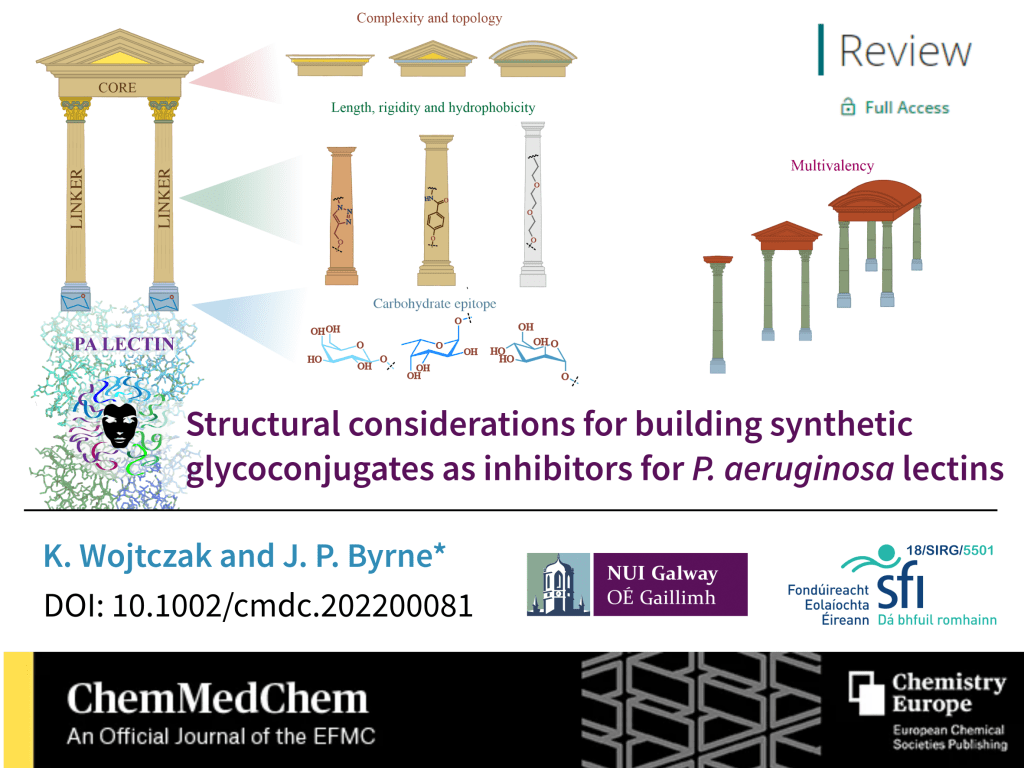
Karolina and Joe’s review article on “Structural considerations for building synthetic glycoconjugates as inhibitors for Pseudomonas aeruginosa lectins” has been published by ChemMedChem. The article is available here: https://doi.org/10.1002/cmdc.202200081
Pseudomonas aeruginosa is a pathogenic bacterium, responsible for a large portion of nosocomial infections globally and designated as critical priority by the World Health Organisation. Its characteristic carbohydrate-binding proteins LecA and LecB, which play a role in biofilm-formation and lung-infection, can be targeted by glycoconjugates. In the review, we present the wide range of inhibitors for these proteins (136 references), highlighting structural features and which impact binding affinity and/or therapeutic effects, including carbohydrate selection; linker length and rigidity; and scaffold topology, particularly for multivalent candidates. We also discuss emerging therapeutic strategies, which build on targeting of LecA and LecB, such as anti-biofilm activity, anti-adhesion and drug-delivery, with promising prospects for medicinal chemistry.
This article would be a good entry-point for any researchers considering tackling P. aeruginosa as a target organism, particularly if they want to build lectin-targeting ligands building on the existing consensus in the field on the best structural features to ensure high lectin affinity.
Thanks to Science Foundation Ireland for funding this research.
Our new article, published in RSC Advances (a Gold Open Access journal), describes a series of new ruthenium-centred glycoclusters, which present four carbohydrate motifs around a three-dimensional octahedral scaffold. Multivalent glycoclusters have previously shown the ability to inhibit the carbohydrate-binding proteins which are produced by bacterium P. aeruginosa. Gordon Cooke’s group in TU Dublin tested these new compounds for their ability to inhibit growth of biofilm by P. aeruginosa and we observed that complex 8Gal, with flexible arms between the scaffold core and the galactose motif gave up to 80% inhibition of biofilm, when compared to the control – the other complexes and the ligand did not show antimicrobial activity. We propose that this activity is due to the ability of galactose to interact with the carbohydrate-binding protein LecA.
We thank Science Foundation Ireland for financial support for this work, as well as UCD School of Medicine’s SSRA Scheme, where preliminary studies began.
In new research, carried out in University of Bern, we have shown that triazolium iodides are excellent catalysts for the oxidative coupling of benzylamines, due to a synergistic cation/anion effect, with iodide acting as I−/I2 redox manifold and the triazolium cation facilitating the iodine reduction and concomitant substrate oxidation. Oxygen was is the terminal oxidant for this process.
The research emerged from the dual interest in the Albrecht group in catalysis and the use of triazolium salts – typically as precursors to organometallic complexes. Joe followed up on some unexpected catalytic activity of triazolium iodides with a series of experiments and control experiments to determine the origins of the reactivity, the role of atmospheric oxygen as terminal oxidant, the importance of the iodide/iodine redox couple and the accelerating effect of the triazolium ion. We hope this work will inspire others to look at the role of heterocylcic compounds in other processes catalysed by iodine.
Joe was part of a collaborative project between University of Bern (Switzerland) and Universitat Jaume I (Spain), which was recently published in ChemCatChem. This work describes the use of mesoionic iridium(III)-NHC complexes as catalysts for efficient dehydrogenation of carbohydrates in water. Without the need for additives, these complexes compare were to previous work published by Dr Jose Mata’s group, using imdazolylidene iridium(III) complexes, along with sulfuric acid.
Introducing abnormal triazolylidene NHC complexes from the Albrecht lab, allowed for this further enhancement of activity for this interesting reaction, which releases hydrogen from carbohydrate substrates, giving only the carbohydrate acid (e.g. gluconic acid) as a by-product, which has potential utility as a initial platform chemical for further synthesis, derived from biomass feedstocks.
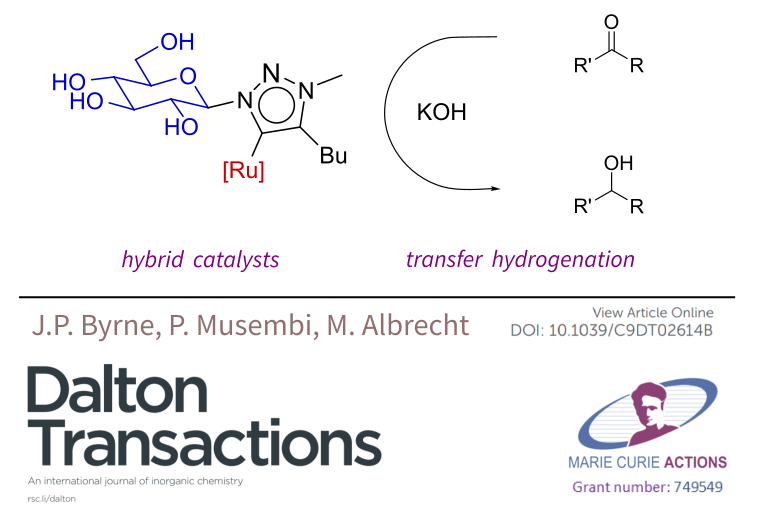
I’m delighted to finally publish this work, the first of my research carried out during my Marie Curie Fellowship in University of Bern to come out. A lot of hard work by Erasmus student Pauline went into gathering data behind this manuscript where we asked the question – what impact would incorporating carbohydrates into the structure of a Ruthenium(II)-triazolylidene complex have on its ability to convert a ketone to an alcohol via transfer hydrogenation catalysis.
There were challenges in isolating the desired compound, so it had to be generated in situ, but we were able to assess the activity, and the results were interesting, and can be found in detail here in Dalton Transactions.
To summarise the conclusions: The carbohydrate functionality does impact catalytic activity (transfer hydrogenation of ketones). In complexes with the glucose directly triazolylidene-bound, turnover rates were substantially higher when compared to more remote carbohydrate functionalisation (i.e. with an ethylene spacer). Both new complexes, however, have reduced activity compared to unfunctionalised carbene complexes. Insight was also gained into the nature of the catalytic cycle through a substrate scope analysis.




 Byrne Research Group