D’eagraigh Joe agus Cathal Kelly imeacht á phlé cúrsaí thaighde ceimice trí mheáin na Gaeilge. | Joe and Cathal Kelly organised an event discussing chemical research through the medium of the Irish language.
Tagairt iomlán PDF anseo / Full PDF report here: “Tagairt: Ceimic 2024”
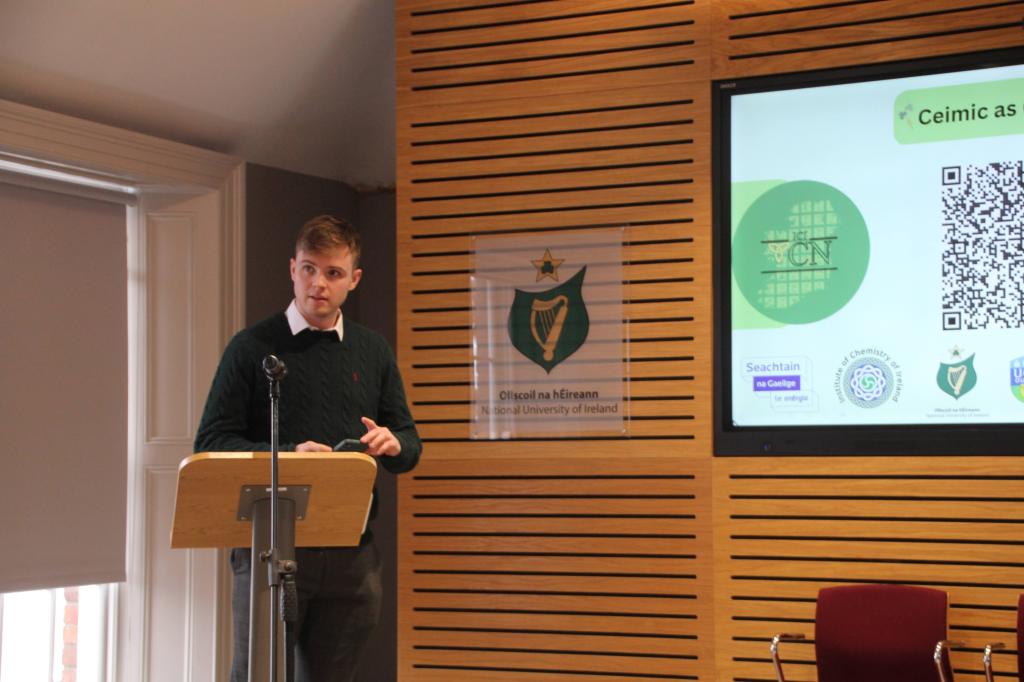




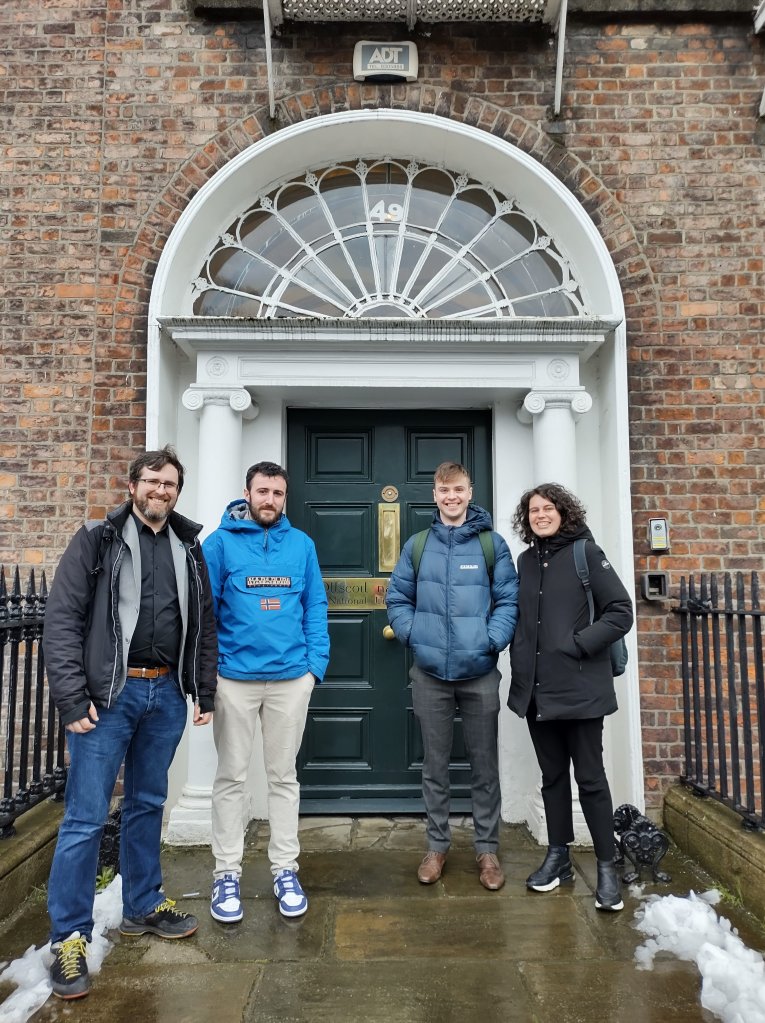
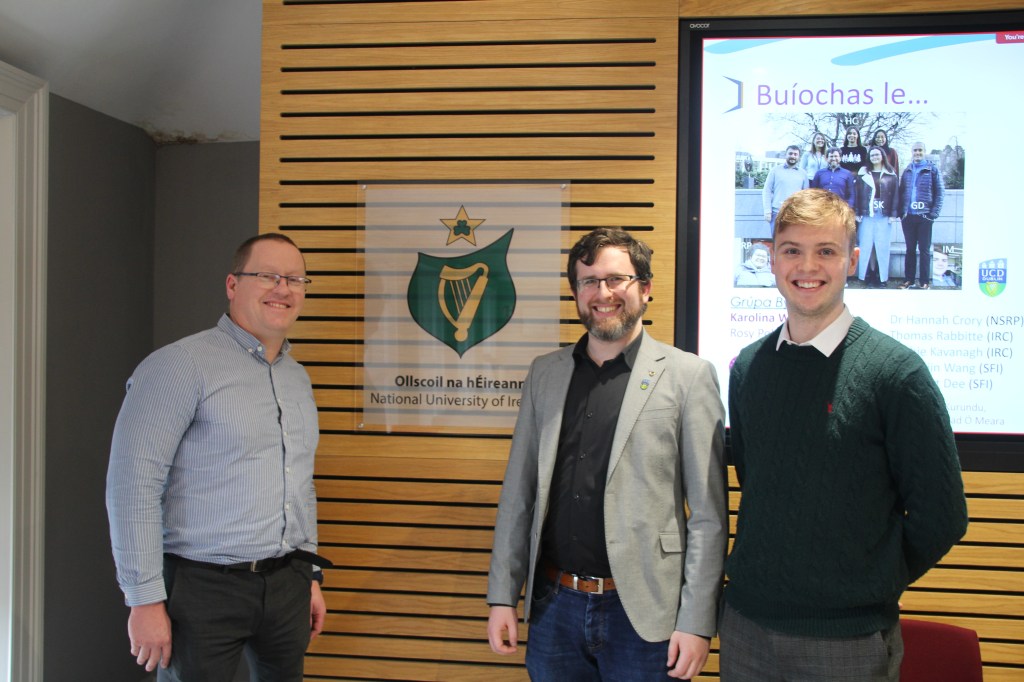
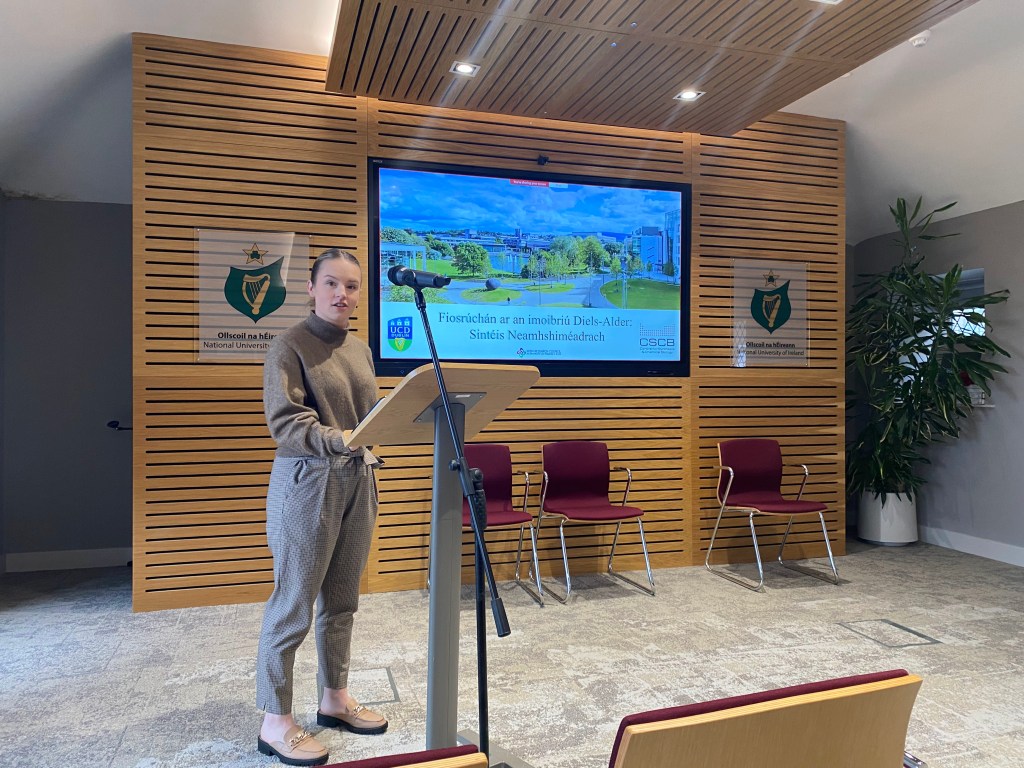

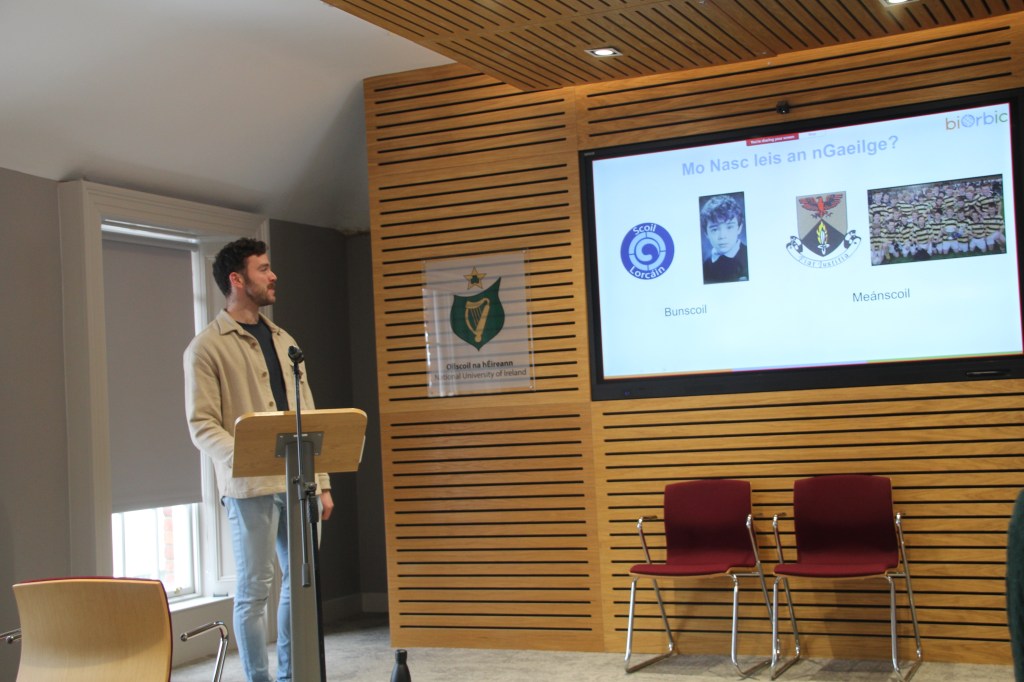

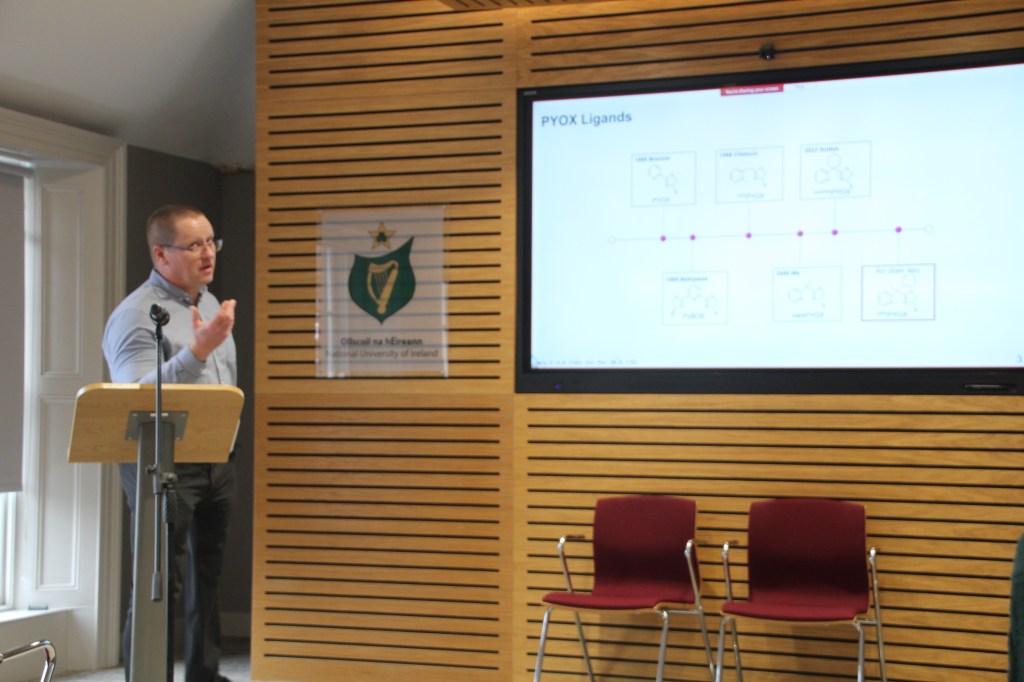
| Ar 1 Márta, le tús a chur le Seachtain na Gaeilge, bhí imeacht eagraithe ag Líonra na gCeimiceoirí Óga ICÉ (LCÓ) chun deis a thabhairt do chemiceoirí na tíre a gcuid taighde a phlé trí mheáin na Gaeilge. Bhí Ceimic as Gaeilge 2024 mar an gcéad imeacht dá short riaimh. Bhí Ceimic as Gaeilge comh-eagraithe ag Leas-Cathaoirleach LCÓ Cathal Ó Ceallaigh (Ollscoil na Ríonna, Béal Feirste) agus Comhairleoir an Dr Iósaf Ó Beirne (Coláiste na hOllscoile, Baile Átha Cliaith), le tacaíocht ó Choiste an LCÓ uile, ach go háirithe Cathaoirleach Seán Byrne. Tá míle buíochas de dhíth ag foireann Ollscoil na hÉireann ag 49 Cearnóg Mhuirfeann Thoir a chuir fáilte fliúirseach agus tacaíocht roimh an imeacht, ach go háirithe Cláraitheoir na hOllscoile an Dr Patrick O’Leary. | On the 1st of March, to begin Seachtain na Gaeilge, the ICI Young Chemists Network (YCN) organised an event giving opportunities to the country’s chemists to discuss their research in the Irish language. Ceimic as Gaeilge 2024 was the first ever event of its type. Ceimic as Gaeilge was co-organised by YCN Vice-Chair Cathal Kelly (Queens University Belfast) and Advisor Dr Joseph Byrne (UCD), with support from the rest of the YCN Committee, in particular Chair Seán Byrne. Sincere appreciation also to the team of the National University of Ireland at 49 Merrion Square East who heartily welcomed and supported the event, especially Registrar of the NUI, Dr Patrick O’Leary. |
| D’oscail Cathal Ó Ceallaigh imeachtaí an lae le fáilte a chuir roimh na aoí a tháinig trín sneachta gan choinne a thit ar maidin. Faraor theip ar cúpla daoine freastail ar an imeacht i mbliana mar gheall ar iompair poiblí teoranta an lae. Chuir an Dr Patrick O’Leary, Cláraitheoir OÉ, fáilte foirmiúil roimh na toiscairí chuig an ionaid. Dúirt sé go raibh lúchair ar OÉ an imeacht a óstáil, ag cur leis “Cuireann ár bplean straitéiseach de cheangal orainn dul chun cinn a dhéanamh lenár gcuid cumas sa Ghaeilge agus le tacú le imeachtaí mar seo.” Go dtí cúpla bliain ó shin, bhí an Dr O’Leary ina léachtóir ceimice ag Ollscoil na Gaillimhe, agus ghlac sé an deis a bheith páirteach sa chomhdháil trí chur i láthair taighde ar shintéis na gcatalaíoch nua. Úsáidtear na catalaíochí seo in imoibrithe atá tábhachtach d’ullmhú cógaisíochta. Déanann siad na imoibriú níos éifeachtaí agus níos iontaofa. | Cathal Kelly opened the day’s proceedings by welcoming all the attendees who a come through the unexpected snow that fell that morning. Unfortunately, some people were unable to attend due to the day’s limited public transport. Dr Patrick O’Leary, Registrar of NUI, formally welcomed delegates to the venue. He said NUI was delighted to host the event, adding “Our strategic plan commits us to developing our abilities in Irish and to supporting events like this.” Until a few years ago, Dr O’Leary was a chemistry lecturer in University of Galway, and he took the opportunity to participate in the conference, presenting research on the synthesis of new catalysts. These catalysts are used in reactions that are important for pharmaceutical preparation. They make the reactions more efficient and reliable |
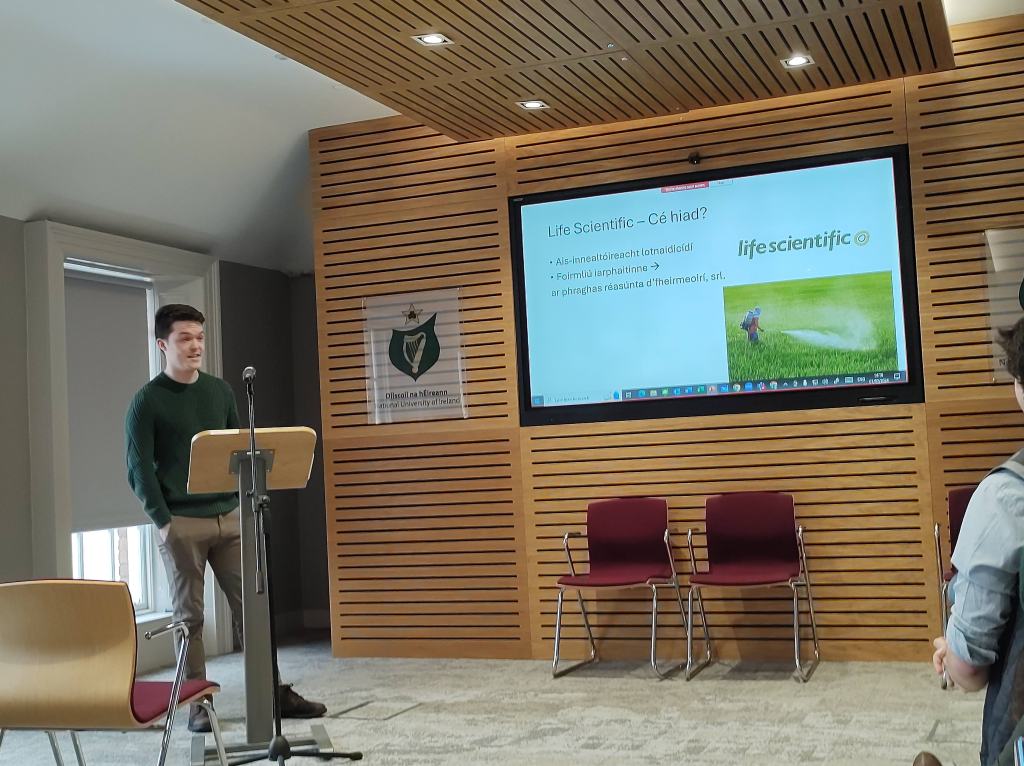
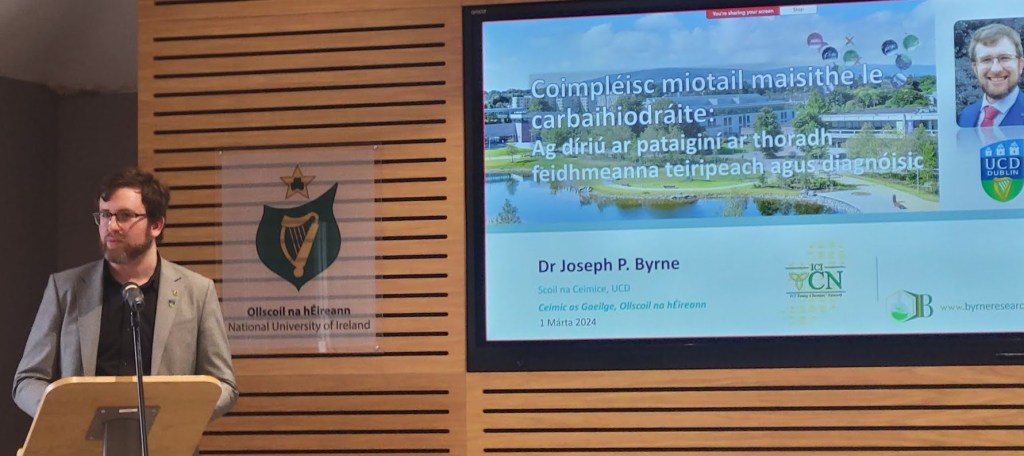
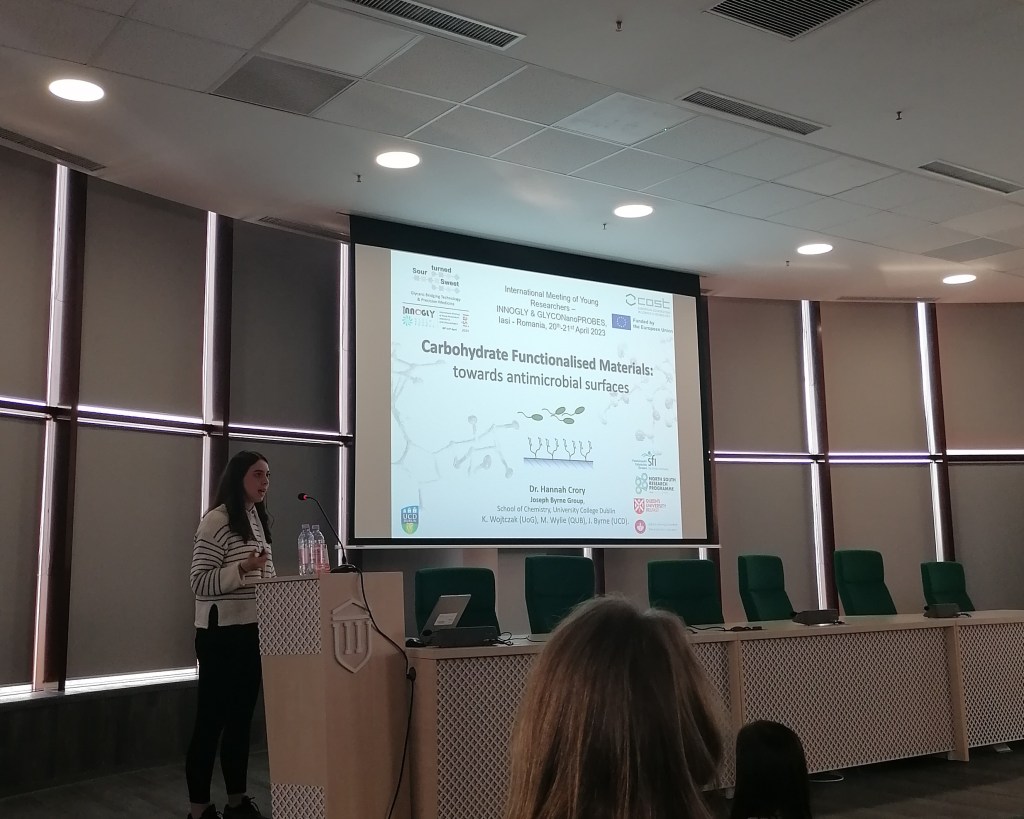
| Chuir Maitiú Ó Ciarnáin (COBÁC) ó Ghrúpa Paul Evans tús le léirithe na mic léinn iarchéime, á phlé a chuid taithe taighde sa cheimic orgánach. Tá N-heitrichiorcail sáithithe mar cheann de na móitíf structúrach is comónta i ndrugaí agus i dtáirgí nádurtha. De thoradh seo tá an-tábhacht ag baint le forbairt imobirithe nua i dtreo na móilíní seo a cruthú i mbealach éifeachtúil agus roghnaitheach. Rinne Maitiú cur síos ar iarrachtaí s’aige agus a chomhoibrí chun teacht ar dhá imoibriú nua; (1.) Sintéis neamh-shiméadrach pioróilidíní trí chatalú tiacarbamáite; agus (2.) Sintéis raicéamach aiseitidíní trí úsáid heacseafluairiseaprópánól. Labhair Niamh Ní Shé ó Ghrúpa Gunnlaugsson (CnaT)faoin a cuid oibre le “Móilíní atá idirghaolmhar go meicniúil agus Micreascópacht”, ach go háirithe caitéineáin agus rothacsáin. Labhair sí faoin gceimic formhóilíneach, steiréiceimic mheicniúil agus stair na ceimice seo agus na móilíní atá faoi thaighde aici. Thaispeán Niamh aidhmeanna a cuid tionscadail, ina measc úsáid compléisc lantanóidigh mar stopadóirí rothacsáine, agus cruthú braitheoirí nó ghéataí loighic le rothacsáin bunaithe ar btp (2,6-bis(1,2,3-tríasól-4-il)piridín). Úsáideann a grúpa taighde an moitíf btp mar theimpléad ar na struchtúir móilíneacha seo. Phléigh sí an sintéis, an iomoibriú ‘clic’ coparchatalaithe agus na turgnamh a bharrfheabhsaigh na dáil iomoibrithe chun macraichiogal btp a dhéanamh go roghnaitheach. Thaispeáin Niamh íomhánna leictreonmhicreascóip scanacháin a léirígh na struchtúir éagsúla cruthaithe le úsáid tuaslagóirí difriúil. Chuir an chuid seo den chaint béim ar féidireacht na móilíní seo féinchóimeáil a dhéanamh. Mar achoimre, bhí an caint seo faoin na haidhmeanna agus scóip a bhaineann lena cuid oibre, an sintéis a úsáidtear agus na n-uirlis anailíse a úsáidtear sa thionscadal. Cuireadh tús leis an gcur i láthair ag Eoghan Ó Curnáin leis an taighde ar lotnaidicídí foirmlithe le micreacapsúil in-bhithmhillte, a rinneadh ar shocrúchán le Life Scientific. Ina dhiaidh sin, pléadh sintéis na substráite agus barrfheabhsú an imoibrithe DAAA Pd-chatalaithe de chomhdhúil heitrea-fáinneach ina bhfuil sulfair acu, atá ar siúil aige i nGrúpa Uí Ghadhra (COBÁC). Ar deireadh, soláthraíodh cúlra agus plean an tionscadail chun imoibriú Suzuki neamh-shiméadrach a bhaint amach, agus é seo a chur i bhfeidhmin in ullmhú liogann-P,N ciriúla i leith na haise. Labhair An Dr Iósaf Ó Beirne (COBÁC) faoin taighde atá ar siúil sa ghrúpa ‘s aige le coimpléisc miotail maisithe le carbaihiodráite. I gcomhthéacs an dúshlán frithsheasmhachta in aghaidh ábhar frithmhiocróbach, tá siad ag iarradh dhíriú ar pataiginí i mbealach nua, ina bhaintear feidhm as prótéiní áirthe a nascann le carbaihiodráite (ar a ghlaotar ‘leictiní’). Rinne Joe cur síos ar dhá sort glicea-bhraisle miotal-lárnach, bunaithe ar scafall btp (2,6-bis(1,2,3-tríasól-4-il)piridín) nó dpa (2,6-décarbocsaipiridín). Bhí éiféacht frith-bhithsceo ag coimpléisc btp Ru(II) nach raibh le fáil leis an liogann amháin – in aineoinn go raibh siad neamh-bhaictéiricídeach. Rinneadh réimse coimpléisc dpa le miotail éagsúla, ach bhí an éifeacht is mó frith-Pseudomonas aeruginosa ag coimpléisc eorapiaim(III). Léirigh sé fresin an féidireacht a bhí ag coimpléisc galachtósíde Tb(III) (le spáisire oiriúnach) mar braiteora leictiní lonnrachta, a éirigh níos gile nuair a bhí leictin a nascann galachtós ann. Gabh an Dr Ó Beirne buíochas leis an lucht a tháinigh inniu agus tharraing sé aird ar saibhreas an phlé a bhí ar siúil trí cheisteanna agus freagra suimiúla i ndiadh gach léiriú. Soláthraigh sé fiúntas an lae. Leis an méid sin ráite, ghlacadh sos caife agus cainte neamh-fhormúil. | Matthew Kiernan (UCD) from the Paul Evans Group put a start to the postgraduate student talks, discussing his experience with organic chemistry research. Saturated N-heterocycles are some of the most common structural motifs in drugs and natural products. As a results of this, great importance is associated with developing new reactions towards creating these molecules in effective and selective ways. Matthew described the efforts he and his team have made to come up with two new reactions; (1.) Asymmetric synthesis of pyrolidines through thio-carbamate catalysis; and (2.) Racemic synthesis of azetidines through the use of hexafluoroisoproanol. Niamh O’Shea from the Gunnlaugsson Group (TCD) was talking about her work with “Mechanically Interlocking Molecules and Microscopy”, especially catenanes and rotaxanes. She spoke about supramolecular chemistry, mechanostereochemistry and the history behind this chemistry and the molecules she is researching. Niamh showed the aims of her Project being the use of lanthanides as stoppers for btp (2,6-bis(1,2,3-triazol-4-yl)pyridine) rotaxanes and the aims for the creation of sensors or logic gates with the rotaxanes. Her research group uses the btp motif for the templating of these molecular structures. She discussed the synthesis, Cu-azide click reactions and experiments to optimise reaction conditions to selectively produce btp macrocycles. Niamh displayed Scanning Electron Microscopy Images and the different structures created when you use different solvents. This part of the talk highlighted these molecules’ ability to self-assemble. In summary, the talk was about the aims and scope of the work, the synthesis being deployed, and the analytical instruments being used in the project. Eoghan Courtney’s presentation began with an overview of the research into developing a biodegradable microcapsule pesticide product, which he did on placement in Life Scientific. Following that, the synthesis of the substrate and the initial optimization of the Pd-catalyzed DAAA reaction of sulfur-containing heterocycles that is on-going in the Guiry Group (UCD) were discussed. Lastly, the background and project outline for achieving asymmetric Suzuki reaction in the preparation of axially chiral P,N-ligands were provided. Dr Joseph Byrne (UCD) spoke about the research that is underway in his group with carbohydrate-functionalised metal complexes. In the context of the challenge of antimicrobial resistance (AMR), they are trying to target pathogens in a new way, making use of specific carbohydrate-binding proteins (called ‘lectins’). Joe described two kinds of metal-centred glyco-cluster, based on the scaffolds btp (2,6-bis(1,2,3-triazol-4-yl)pyridine) or dpa (dipicolinic acid). Ru(II) btp complexes had an anti-biofilm effect that was not observed with the ligand alone – despite not benign bactericidal. A range of dpa complexes with various metals were made, but the europium(III) complexes had the largest anti-Pseduomonas aeruginosa effect. He also demonstrated the capability of galactoside Tb(III) complexes (with appropriate spacer) as luminescent lectin sensors, that became brighter when a galactose-binding lectin was present. Dr Byrne thanked the attendees for coming today and drew attention to the wealth of discussion that was taking place through interesting questions and answers after each talk. This demonstrated the value of the day. With that said, a break for coffee and informal discussion took place. |
| Thosaigh an dara seisiún leis an cainteoir a tháinig ón áit is faide don imeacht inniu. Rinne Cathal Ó Ceallaigh (CnaRBF) cur síos ar a thaighde i leachtanna scagacha. Léiríú go gcrúthaíonn scagacht méadú ar ionsú gáis na leachtanna seo. Aimsíú nach seo an cás nuair a n-úsáidtear CO2. Cuireadh an locht ar “spás curtha amú”, coincheap nua i leachtanna scagacha. Cruthaíonn mórchóir steireach an óstmhóilín spás nach úsáideann na mhóilíní gáis, agus cruthaíonn seo laghdu ar an ionsú gáis. Rinneadh cur síos ar bealaí a d’fhéadfadh an spás curtha amú seo a laghdú: trí méid na móilíní tuaslagóirí a laghdú agus scagacht éifeachtacht an óstmhóilín a mhéadú. An teideal a bhí ag léiriú Eoin Mac Aoidh Pasquetti (COBÁC),ó Ghrúpa Grace Morgan, ná “Saol Maighnéadach an Adaimh: Réamhrá ar Aistriú Guairne”. Deineadh plé ar aistriú guairne; Cén rud é?, Conas a scrúdaítear?, is cad iad na feidhmeanna a bhaineann leis? Deineadh cur síos bunúsach ar Cheimic Chomordánaithe is ar an slí a éiríonn aistriú amach as an mbaint atá ann idir stát guairne an adaimh agus an neart atá sa réimse liogainn. Deineadh plé ar na teicnící is tábhachtaí a bhaineann le aistriú guairne agus ar an eolas is féidir a bhaint astu. Ar deireadh, tugadh samplaí dosna hábhair gurbh fhéidir aistriú guairne a chur i bhfeidhm iontu agus ábhair go bhfuil sé i bhfeidhm iontu cheana féin. Labhair Aoibheann Ní Chonchubhair (COBÁC) ó Ghrúpa Uí Ghadhra ar fiosrúchán ar an imoibriú Diels-Alder neamhshiméadreach. Is grúpa sintéis neamhshiméadreach é an Grúpa Uí Ghadhra, agus sa chur i láthair seo bhíodar ag díriú ar an úsáid do chuiditheoir ciriúlacht mar stratéis chun neamhshiméadreacht a chruthú. Ag úsáid an imoibriú dé-éin a bhí dearrtha acu cheana féin i gcomhair móilíní nítrigin, agus le spreagadh ón obair Evans i 1984, d’úsáidtear an imoibriú sin chun dé-éin a chur ar an chuiditheoir ciriúlacht, in ionad ar an dé-éinifileach. Chruthaítear thart ar 12 shampla don dé-éin le cuiditheoir ciriúlacht le toradh suas go dtí 97%, níos mó ná 50 shampla don táirge Diels-Alder le toradh suas go dtí 70% agus id suas go dtí 93:7, agus 5 shample don tárige gan an cuiditheoir ciriúlacht le toradh suas go dtí 81% agus ie suas go dtí 92%. D’éirigh leo structúr criostail a bhaint amach don dé-éin, dos na tháirge DA agus don táirge gan an cuiditheoir ciriúlacht. Bhíodar in ann eolas cruinn faoin structúr agus neamhshiméadrach tríd an córas anailíse seo, nach fhéadfaí stadéir le anailís AMN in aonar. Rinne An Dr. Gearóid Ó Maille (CET), a bhí ag glacadh páirt ón mBruiséil ar MS Teams, cur síos ar a chosán gairme féin, ón saotharlann go ról mar Oifigeach Eolaíochta sa gCoimisiún Eorpach. Thug sé eolas ar dheiseanna maoinithe do thaighdeoirí faoin gClár Réime “Fís Eorpach”, le béim ar chlár na Comhairle Eorpaí um Thaighde (CET). Is e an CET príomhmhaoinitheoir an Chomisiún Eorpaí do thaighde ar thús cadhnaíochta, agus tá raon deontais curtha ar fáil do eolaithe ag céimeanna gairme difriúla. Tugadh chun cuimhne freisin an nasc láidir a bhí idir ceimic agus an Ghaeilge in Ollscoil na Gaillimhe: mar shampla, scríobh an réabhlóidí agus an t-ollamh clúiteach Thomas Dillon (ceann scoile ó 1919), an chéad leabhar ceimice i nGaeilge. Lean an meas seo ar ár dteanga sna glúnta a lean é: rinne na ceannairí scoile, an tOll. Proinsias Ó Colla, an tOll. Seán Ó Cinnéide agus an tOll. Ristéard N. de Buitléir, gan dearmad a dhéanamh ar na Oll Breandán Ó Cochláin, a gcion féin go dúthrachtach leis an nGaeilge a choinneáil beo sa gceimic. Labhair Gearóid ar an ádh a bhí air go raibh cuid mhór dá chuid léachtanna ceimice trí mheán na Gaeilge agus é ina mhac léinn i nGaillimh, áit ar ghríosaigh an tOll. de Buitléir na mic léinn an fód a sheasamh don teanga trí léiriú don domhan mór gur teanga nua-aimseartha í an Ghaeilge ar féidir í a úsáid le hábhair theicniúla a phlé. Thug sé ómós don bhaicle leachtóirí a mhúin ceimic trí Ghaeilge i nGaillimh: go háirithe an tOll. Pat McArdle, criostalagrafaí agus léachtóir den chéad scoth a fuair bás le rí-ghairid in Eanáir na bliana seo, agus an tOll. Mike Hynes, saineolaí ar chineiticí agus treoraí tuisceanach, a cailleadh i 2022. Bhásaigh an tOll de Buitléir go tobann i 2016. | The second session began with the speaker who had traveled the furthest for today’s event. Cathal Kelly (QUB) described his research into porous liquids. Porous liquids normally show enhanced gas uptakes. It was highlighted how this wasn’t the case when CO2 was employed as the gas being absorbed. This was blamed on “wasted space”, a new concept in porous liquids. The steric bulk of the host molecules creates a space which gas molecules don’t occupy which leads to a reduction in the overall gas uptake. Different ways of reducing this wasted space were described: reducing the size of the solvent molecules and increasing the effective porosity of the host molecules. The title of the talk presented by Eoin McGee Pasquetti (UCD) from the Group of Grace Morgan was “The Magnetic Life of the atom: Introduction to Spin Crossover”. The topic of spin exchange was discussed; What is it? How can it be examined? And what are its applications? A basic description of Cooridination Chemistry was given, and of the manner that crossover gets out of the link between the spin state of the atom and the strength that is in a range of ligands. Important techniques related to spin crossover, and on the information that may be gleaned from them, was also discussed. Finally, examples of subjects in which spin crossover could be utilised as well as areas where they are already in use. Aoibheann O’Connor (UCD) from the Guiry Group spoke about the investigation on the asymmetric Diels-Alder reaction. The Guiry group is an asymmetric synthesis group, and this presentation was directed on their use of chiral auxiliaries as a strategy for inducing asymmetry. Using a previously designed dienylation reaction for nitrogen containing molecules, and drawing on inspiration from the work of Evans in 1984, they used this same dienylation reaction to install a diene on the chiral auxiliary, instead of installing a dienophile on it. They have prepared 12 examples of the diene with the chiral auxiliary with yields up to 97%, more than 50 examples of the Diels-Alder product in yields up to 70% and dr up to 93:7, and 5 examples of the product without the chiral auxiliary in yields up to 81% and ee up to 92%. They accessed XRD structures of the dienes, the Diels-Alder products and the compounds without the chiral auxiliary. They could obtain crucial structural information from this method of analysis that would not be possible with the use of NMR analysis alone. Dr Gearóid Ó Máille (ERC), joining from Brussels via MS Teams, described his career path from the laboratory to his current role as a Scientific Officer at the European Commission. He detailed some funding opportunities available for researchers under the “Horizon Europe” Framework Programme, with particular emphasis on the European Research Council (ERC) programme. The ERC is the European Commission’s flagship funder for frontier research, and a range of grants are available for scientists at different career stages. The strong link between chemistry and Irish in the University of Galway was also commemorated: for example, the revolutionary and famous professor Thomas Dillon (head of school from 1919), wrote the first chemistry book in Irish. This respect for the language continued in the subsequent generations: the school leaders Prof Proinsis O’Colla, Prof Seán Ó Cinnéide and Prof Richard (Dick) Butler, not to forget Prof Brendan Coughlan, who each did their share fervently to keep Irish alive in chemistry. Gearóid spoke about how lucky he was to have a large share of his chemistry lectures through the medium of Irish when he was a student in Galway, a place wher Prof Butler urged students to stand their ground for the language by demonstrating to the world that Irish was a modern language that could be used to discuss technical matters. He paid respect to the group of lecturers who taught chemistry through Irish in Galway: especially Prof Pat McArdle, a first-rate crystallographer and lecturer who died very recently in January of this year, and Prof Mike Hynes, an expert in kinetics and understanding teacher, who passed away in 2022. Prof Butler died suddenly in 2016. |
| Léirsigh an imeacht seo go raibh sé in-déanta plé leathan ar cúrsaí thaighde ceimice a chur i láthair trí mheáin na Gaeilge, agus go bhfuil éileamh ann freisin san ETIM. Dá mbeadh suim ag éinne a bheith páirteach in imeacht mar seo sa todhchaí, téigh i dteagmhál le joseph [ponc] byrne [ag] ucd [ponc] ie | This event demonstrated that it is completely possible to present broad discussion on topics of chemistry research in the Irish language, and that there is also demand for this in STEM. If anyone is interested in taking part in events like this in future, get in contact with joseph [dot] byrne [at] ucd [dot] ie |











 Byrne Research Group