Our new article, published in RSC Advances (a Gold Open Access journal), describes a series of new ruthenium-centred glycoclusters, which present four carbohydrate motifs around a three-dimensional octahedral scaffold. Multivalent glycoclusters have previously shown the ability to inhibit the carbohydrate-binding proteins which are produced by bacterium P. aeruginosa. Gordon Cooke’s group in TU Dublin tested these new compounds for their ability to inhibit growth of biofilm by P. aeruginosa and we observed that complex 8Gal, with flexible arms between the scaffold core and the galactose motif gave up to 80% inhibition of biofilm, when compared to the control – the other complexes and the ligand did not show antimicrobial activity. We propose that this activity is due to the ability of galactose to interact with the carbohydrate-binding protein LecA.
We thank Science Foundation Ireland for financial support for this work, as well as UCD School of Medicine’s SSRA Scheme, where preliminary studies began.
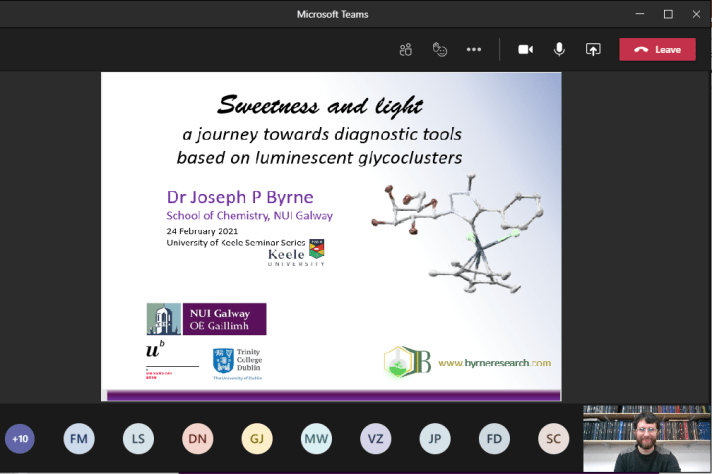
Joe delivered a seminar to postgraduate students and academic staff at Keele University as part of their annual Seminar Series. Joe was invited to speak by Dr Chris Hawes, Lecturer in Inorganic Chemistry at Keele. The seminar was entitled “Sweetness and light: a journey towards diagnostic tools” and described the research which underpins the current work in the Byrne group as well as some recent results.
Karolina was selected to give a presentation at UCC’s Chemistry Le Chéile Conference. This was an event aimed at improving the visibility of women in chemistry research and industry, by showcasing postgraduate academic research and industry speakers.
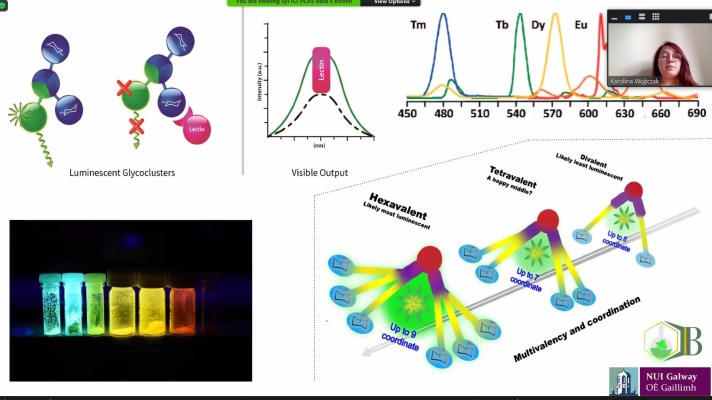
Karol spoke about her PhD work, developing luminescent glycoconjugates for bacterial sensing applications.
Joe gave an oral presentation about his work with carbohydrate-functionalised metal complexes at the 2020 Irish Biological Inorganic Chemistry Symposium in November. The annual IBICS meeting, and subsequent AGM, were held online this year and were well attended. Before his talk, Prof Celine Marmion, the president of IBICS, drew attention again to his role in organising the ICI Postgraduate Chemistry Research Symposium in September. The talk was followed by a number of questions from the attendees.
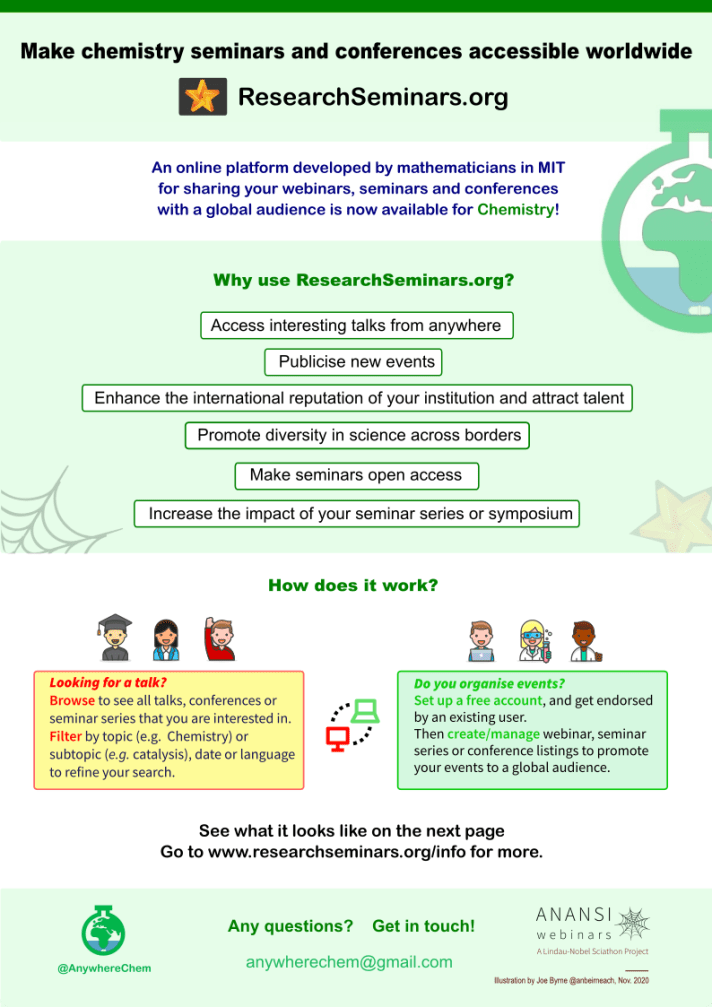
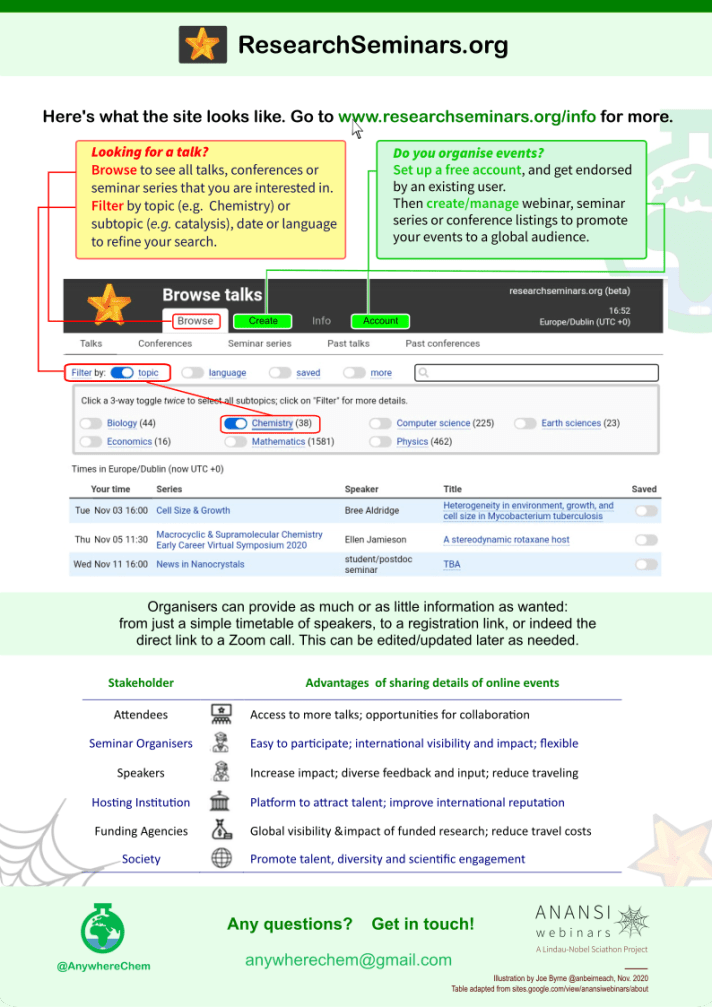
Since working on Project Anansi as part of the Lindau Sciathon event, I’ve been very interested in the prospect of implementing a platform that would allow chemists to share open access webinars, thus broadening their audience globally. See the previous posts [1 and 2] for more details on why. Anansi partnered with the team in MIT who had developed http://ResearchSeminars.org earlier in 2020 to expand their platform to support other disciplines (including Chemistry and Economics).
I worked together with @AnywhereChem in order to develop a list of sub-topics in chemistry, which are now listed on ResearchSeminars website. Please see below an email I have circulated asking people to consider adding content. The flyer is available here [PDF].
Make chemistry seminars and conferences accessible worldwide: ResearchSeminars.org
Dear colleagues
I would like to draw your attention to a new resource now available to chemists to both share and discover webinars, talks, conferences and more, which are happening online all around us: http://ResearchSeminars.org/info
This strange year with its lockdowns and travel restrictions has been very difficult, however one silver lining has been a golden age in online chemistry talks on every topic imaginable, available right at your desk. It has become clear that online research talks, seminars and conferences are here to stay in one form or another, even as many other aspects of our work return to normality. This will continue to benefit researchers and students, particularly those who are not based in big universities or large cities, including researchers in the developing world. However, it is still very challenging to keep up-to-date with all these interesting events with different hosts advertising in different ways, and making sure you don’t miss the most relevant talks.
ResearchSeminars.orgcan be a solution to that obstacle. Some mathematics researchers at MIT built this free site, which is available to all and has valuable search tools, such as filtering by topic and language. Thanks to our positive interactions with the founders, since September, the site is accepting Chemistry talks. This is in addition to its use to great effect by researchers in Physics, Maths, Biology, Economics and Earth Sciences, which were supported since earlier in 2020, now totalling thousands of talks. Adding listings is easy (requires a free account) and will amplify the possible audience of your events once chemists start using this resource in earnest. Making our seminars and events “open access” is a positive step and ought to be the default choice unless a speaker does not wish to (e.g. presenting unpublished results). I know from my experience of organising a seminar series during lockdown that many of our speakers welcomed the opportunity to invite guests and promote their talk more widely when given the option to share a link on Twitter.
During this year, Twitter has been a great resource for keeping up to date with online events. For nearly 6 months, @SuperScienceGrl kept an index of upcoming webinars in addition to an ongoing list of chemistry conferences. The Twitter account @AnywhereChem was set up in response to the glut of exciting talks online, in order to share them far and wide and make sure no one missed out. Many of us benefited from this increased publicity alerting us to relevant talks. It is not sustainable to rely on just a few individuals, however, to keep the entire community up to date. ResearchSeminars.org provides the opportunity for event organisers themselves to commit to posting their timetables in a central database, making it easier for others like @AnywhereChem to publicise further from there.
I am asking you to seriously consider adding any upcoming events you are organising to ResearchSeminars.org and give researchers around the world an opportunity to find out more about what is happening in your university, research group or organisation. If you are planning to attend an online event in the near future, please forward this email to the organiser and see if they will take part. And most importantly, check in to see if any events in your field are occurring soon. This is a great opportunity to open the doors of seminar halls around the world and to the benefit of all.
Please find attached a flyer highlighting the main points and advantages of this new platform. I encourage you to forward this further to your network and to get in touch if you have any questions.
Kind regards, Dr Joseph Byrne, School of Chemistry, NUI Galway
[Press release] The inaugural Institute of Chemistry of Ireland Postgraduate Chemistry Research Symposium (ICI PCRS) took place on September 9th 2020, with over 150 registered delegates joining the conference over Zoom call throughout the day. This online event was designed to give postgraduates an opportunity to share their research results, in a year when most physical conferences have been cancelled.
Professor Celine Marmion, President of the Institute of Chemistry of Ireland opened the event by thanking the organising committee for arranging such a varied programme in a very short space of time. Acknowledging that it has been a difficult year for postgraduate students, having been shut out of their universities for many months by Covid-19 restrictions, she thanked the organisers of the Symposium for quickly bringing together a new event in this challenging time to present an opportunity to postgraduate students to present their work and build their profiles. Professor Marmion launched the competition for this year’s ICI Postgraduate Award. The 2019 winner of the ICI Postgraduate Award Saoirse Dervin delivered her award lecture at the end of the day.
Flash and oral presentations by postgraduate chemists made up the bulk of the programme, organised into four thematic sessions, with topics ranging from medicinal and synthetic chemistry to supramolecular and analytical chemistry. In total 43 PhD students from all over the island of Ireland shared their work with their peers.
The symposium also hosted the first ever mental health seminar delivered at an Irish chemistry event. Delivered by Miffy Hoad of Mental Health Ireland, the two 30-minute sessions gave concrete methods on how to stay connected, reduce stress, increase mindfulness and cope with these unprecedented times.
The event design also included time for meaningful connection and networking, with breakout rooms used to allow small groups to meet each other and talk about the content of the 13 research posters on display.
Dr. Adele Gabba of Johannes Gutenberg University Mainz, who won the ICI’s Postrgraduate Award in 2018, delivered a unique and unforgettable career talk, bravely sharing both her personal successes and struggles, and outlining how this has influenced her and her career. Industrial chemists also delivered career talks to the assembled young chemists, including Will Gough & Yeliz Genc from GSK as well as by Dr. Patrick Kielty from Abbvie.
In total, 11 of Ireland’s top research institutions were represented in flash and oral presentations, with a number of international attendees also tuning in. Nine prizes were sponsored by the ICI, the European Young Chemists’ Network and Eurachem.
Lorna Conway from UCD, winner of the ICI Award for Best Oral Presentation said of the day: “I thought that it being online and free to attend made it very accessible. It meant taking less time out of the the working week to attend, which is always good. Not only was it great to see the vast range of interesting topics being researched by our fellow postgraduates, but it was also a wonderful opportunity to connect and network with our colleagues at such a strange time. ”
Fiona Gordon from NUI Galway, winner of the Eurachem Prize for Best Flash Presentation said: “The symposium was an excellently organised event provided by the ICI. It was the first conference I attended since the start of the COVID-19 outbreak. The event provided me a great platform to share my research. It was nice to meet with PhD students in the different universities and see the diversity of chemistry research happening in Ireland! Overall it was a very enjoyable day. The organising committee did a fantastic job in making the event possible and running the event so smoothly”
A notable aspect of this symposium was that the organising committee was made up of postgraduate students nominated by various Third Level Institutions across Ireland, in order to represent the diversity of research interests in the country and create a unique event designed for postgrads and by postgrads. Dr Mark Kelada (ICI Young Chemists Representative) and Dr Joseph Byrne (NUI Galway) coordinated the meetings, which due to the current times, all, just like the event itself, took place over Zoom. The members of the committee, who chaired various sessions of the Symposium were: Colm McKeever (Maynooth University), Fionn Ó Fearghail (Technological University Dublin), Jessica O’Neill (Dublin City University), Lauryn Bracken (Athlone Institute of Technology), Lukas Hallen (Trinity College Dublin), Niamh O’Mahoney (University College Cork), Siobhán O’Flaherty (RCSI) and Syl Byrne (NUI Galway).
Organising committee of the ICI Postgraduate Chemistry Research Symposium. Top row: Fionn Ó Fearghail (Techological University Dublin), Dr Mark Kelada (ICI Young Chemists Representative), Colm McKeever (Maynooth University), Lukas Hallen (Trinity College Dublin); Middle row: Jessica O’Neill (Dublin City University), Syl Byrne (NUI Galway), Dr Joseph Byrne (Honorary Research Lecturer, NUI Galway), Lauryn Bracken (Athlone Institute of Technology); Bottom row: Siobhán O’Flaherty (Royal College of Surgeons in Ireland), Niamh O’Mahoney (University College Cork)
Prof. Celine Marmion, President of the ICI said: “On behalf of the Institute of Chemistry of Ireland, I would like to congratulate the symposium organising committee for bringing together our Irish postgraduate chemistry community at a time when many conferences are either being cancelled or deferred as a result of the Covid pandemic. This virtual symposium provided PhD scholars across Ireland with a unique opportunity to showcase their cutting edge research, forge new collaborations and build their professional profiles. A particular strength of the symposium was that it was led by postgraduates for postgraduates. The quality of the research and the tangible enthusiasm of the postgraduate scholars on the day were clearly evident for all to see. ”
A survey was carried out on the day, where 71% of attendees said they would be interested in joining a new professional network targeted at young chemists, in order to continue to connect with and support their peers across the island on an on-going basis. As a result of this level of support, the Council of the ICI approved the establishment of theIrish Young Chemists’ Networkat their meeting on October 1st 2020. This network will be launched formally in the coming weeks and will build on the success of the Symposium in future years.
-ENDS-
The full list of those who won prizes at the Symposium is as follows:
ICI Oral Presentation Prize: Lorna Conway (UCD) Eurachem Flash Presentation 1st place prize: Fiona Gordon (NUIG) EYCN Flash Session 1 Prize: Danielle Curran (UCD) EYCN Flash Session 2 Prize: Iñigo Iribarren Aguirre (TCD) EYCN Flash Session 3 Prize: Alex Horan (UCD) Eurachem Flash Session 4 Prize: Caytlin Boylan (MU) ICI Peoples Choice 1st Place Poster Prize: Ciara-Ruth Kenny (CIT) ICI Peoples Choice 2nd Place Poster Prize: Aoibhín A. Cullen (DCU) ICI Judges’ Choice Poster prize: Sophie M. Connolly (DCU)
Prize winners from the Symposium
About the Institute of Chemistry of Ireland (ICI)
The Institute of Chemistry of Ireland is the professional body representing chemists in Ireland. Its members are chemists who satisfy the requirements of the Institute with regard to qualifications and experience. The Institute promotes the study of chemistry, sets professional standards and organises lectures, meetings and social events for its members. It offers advice and comment to Government in areas relevant to the profession. Irish Chemical News, the official journal of the Institute is published twice yearly. The Institute of Chemistry of Ireland promotes excellence in chemistry through a series of competitions and awards for chemists at all career stages from 2nd level students onwards. More information is available at www.chemistryireland.org
In new research, carried out in University of Bern, we have shown that triazolium iodides are excellent catalysts for the oxidative coupling of benzylamines, due to a synergistic cation/anion effect, with iodide acting as I−/I2 redox manifold and the triazolium cation facilitating the iodine reduction and concomitant substrate oxidation. Oxygen was is the terminal oxidant for this process.
The research emerged from the dual interest in the Albrecht group in catalysis and the use of triazolium salts – typically as precursors to organometallic complexes. Joe followed up on some unexpected catalytic activity of triazolium iodides with a series of experiments and control experiments to determine the origins of the reactivity, the role of atmospheric oxygen as terminal oxidant, the importance of the iodide/iodine redox couple and the accelerating effect of the triazolium ion. We hope this work will inspire others to look at the role of heterocylcic compounds in other processes catalysed by iodine.
She thoroughly enjoyed attending the event as a whole and would like to congratulate all the speakers and organisers for a fantastic job bringing postgraduate scientists in Ireland together even in these times, when sharing and exchanging knowledge in traditional ways is very challenging if not impossible. She is looking forward to next year’s event!
In light of many cancelled events this summer, postgraduate students have missed out on opportunities to share and discuss their research with others. The Institute of Chemistry of Ireland Postgraduate Chemistry Research Symposium has been launched in a bid to address that. Joe and Mark Kelada (ICI Young Chemists representatives) are co-chairing a committee of postgraduate volunteers from various Irish third-level institutes in organising this event, scheduled to take place on Wednesday 9 September 2020.