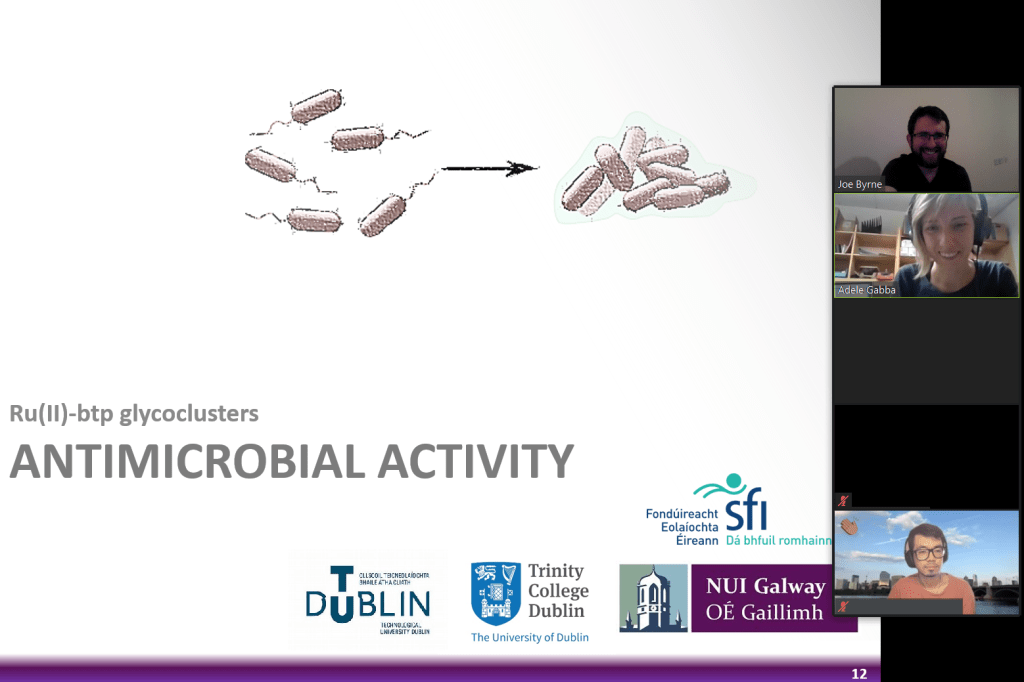
Researchers at NUI Galway and Queen’s University Belfast are investigating how attaching sugar molecules to plastics could help prevent and detect bacterial infections in medical devices (e.g. urinary catheters, endotracheal tubes). Certain sugar molecules can interact selectively with bacterial proteins, and the researchers plan to harness these interaction to make fluorescent materials which glow at first, darkening when they become compromised by bacteria, allowing clinicians to react faster to potential infections before they become a serious risk to patient health. Coating medical devices with these plastics would result in “smart” devices, giving doctors and nurses tools to reduce risks of infection, bring down healthcare costs and decrease the need for antibiotic use in hospitals.
Early-career researchers Dr Joseph Byrne (NUIG) and Dr Matthew Wylie (QUB) have been awarded €193,000 to spearhead the SUGARCOAT project, developing coatings for medical devices using polymers containing sugar molecules, with the support of senior colleagues Prof Abhay Pandit, Director of CÚRAM Centre for Medical Device Research, and Prof Colin McCoy, Head of School of Pharmacy in QUB. The project will bring together complementary expertise from chemistry, pharmaceutical materials science and medical device research to tackle the growing challenge of hospital-acquired infections.
This project is part of the North-South Research Programme, announced by An Taoiseach Micheál Martin TD on 2 March 2022, as part of the Shared Island Fund. [Government Press Release]
Hospital-acquired infections are a major health concern for patients, and also incur significant expense to health systems across the island of Ireland, requiring longer hospital stays and antibiotic use. Patients requiring medical devices are at greater risk, often taking medicines that suppress their immune system making their bodies more susceptible to infection. Infections by dangerous bacteria, such as E. coli and P. aeruginosa have risen significantly in recent years, with medical device-associated infections account for up to half of healthcare-associated infections. Immunocompromised people and people with cystic fibrosis (CF) are particularly affected; Ireland, North and South have among the highest per capita CF incidence.
The rise of antimicrobial-resistant bacteria is an urgent problem highlighted by the World Health Organisation in recent years, decreasing the effectiveness of existing antiobiotics. It is estimated that across EU/EEA countries, 33,000 deaths per year in EU/EEA countries are associated with antimicrobial resistance, costing more than €1bn to health services. This project hopes to minimise the impact of this challenge by producing innovative device coatings, which will prevent or detect bacterial build-up on widely-used medical devices before they lead to infection in a patient.
Speaking about the funding award, Dr Joseph Byrne, Honorary Research Lecturer in the School of Biological and Chemical Sciences, NUI Galway, said:
“Prevention of bacterial infections is key to fighting the challenge of antimicrobial resistance and if this isn’t possible, then early detection through innovative sensing materials, would allow devices to be removed and replaced by healthcare professionals before infection becomes a more serious risk to patient health. Hospital-acquired bacterial infections are a major issue across the entire island of Ireland, and I’m excited to forge a new and lasting relationship with Matthew, Colin and their team in Belfast to deliver meaningful new tools in fighting this challenge.”
“My work in this area is largely fundamental chemistry research, and this funding is a great opportunity will allow me to partner with more patient-facing researchers and healthcare stakeholders to increase our societal impact. Building all-island collaborations through this Scheme will help us to unlock Ireland’s potential for innovation and cutting-edge science.”
Dr Matthew Wylie, Lecturer in Pharmaceutical Materials Science in Queens University Belfast added:
“We are delighted to receive this funding from the Shared Island Fund. The partnership between NUIG and QUB will not only support two early– career researchers but will open up opportunities for collaboration with industry and clinicians in both the North and South of Ireland. Galway is home to a number of major medical device companies. We are excited to have the opportunity to pursue clinical translation of cutting-edge research developed right here in Ireland.
“The team at QUB have vast experience collaborating with medical device companies across the UK and Ireland and working closely with clinicians in Belfast. At the start of the project we will assemble a committee of key stakeholders building a consensus, North and South, to steer development of this innovative sensing technology to address antimicrobial resistance.”
About Shared Island Fund
Last year, €40m was allocated from the Shared Island Fund over five years for the North-South Research programme. This significant development is aimed at supporting the deepening of links between higher education institutions, researchers and research communities on the island of Ireland, delivering all-island approaches to research and innovation.
Announcing the awards, Taoiseach Micheál Martin, said: “These awards will support the Government’s Shared Island vision by bringing researchers from all corners of the island together to work on pioneering projects over the next four years, and is not only strengthening existing relationships, but is fostering new research partnerships.
“I’m particularly impressed by the high level of interest and the calibre of the proposals, and I am confident that these cross-border collaborations will further strengthen the island’s reputation for innovation and research excellence”.
Sixty-two collaborative research projects between academics and institutions in Ireland and in Northern Ireland were awarded a total of €37.3 million under the first funding call from the North-South Research Programme, which is a collaborative scheme funded through the Government’s Shared Island Fund. It is being administered by the Higher Education Authority (HEA) on behalf of the Department of Further and Higher Education, Research, Innovation and Science.
Announcement: https://www.youtube.com/watch?v=eT0sV2TjrAo