Welcome to Rosa, Finn and Hubert

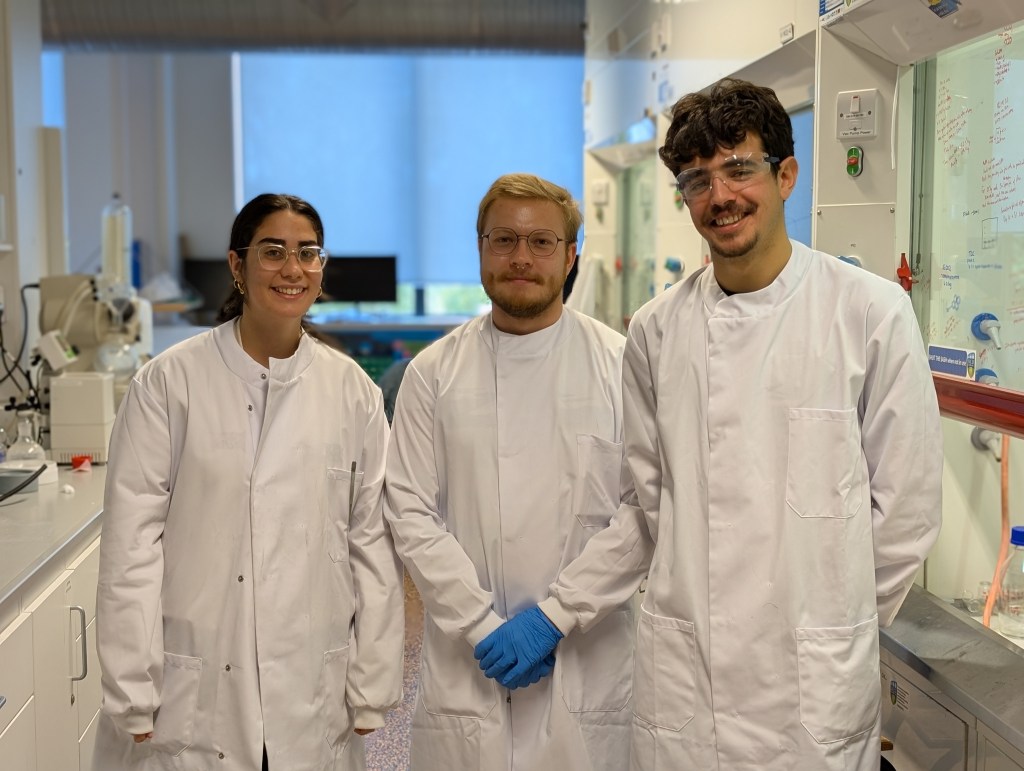
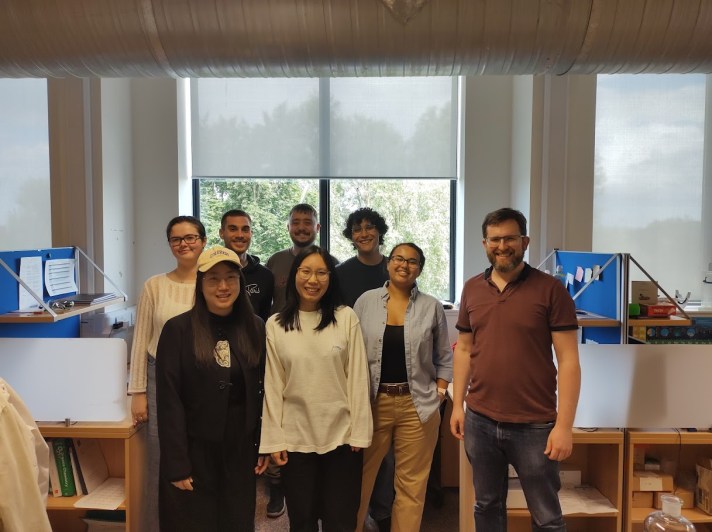
This Autumn we welcome three new members to the Byrne Research Group. The group, at 6 full-time researchers, is the largest it has been to date! Welcome to Rosa, Finn and Hubert – we wish them every success.

Dr Rosa Fernandez Pison joins us as a postdoctoral researcher on the Link4Lectin project, where she will contribute to the coordination chemistry and organometallic components of the target molecules. She completed her PhD in UCD during the summer in organometallic catalyst development. She previously completed a Research MSc at University of Galway, and an undergraduate degree in her native Sevilla (with year abroad in University of York).

Finn Tlatlik holds an MSci from University of Glasgow in Chemistry with Medicinal Chemistry. His degree included a year of research placements in France as well as a project in Glasgow. He is joining us to complete his PhD with a Sir Walter Hartley Studentship, and will be working on optimising the photophysical properties of lanthanide complexes as lectin sensors.

Hubert Rebow is returning to the group, having secured a Government of Ireland Postgraduate Scholarship. Hubert is a recent graduate of UCD’s Medicinal Chemistry and Chemical Biology BSc programme, and completed a final year project in our lab. His project, developing supramolecular boronic acid-based glycan probes involves collaboration with Dr Aniello Palma and Prof Jeremy Simpson.

Lab Awarded Sustainability Certificate

The Byrne Group were delighted to be awarded a Green Certification from MyGreenLabs, as part of Research Ireland’s Sustainable Laboratory Certification Pilot Programme. In Lab A2.01, we worked together with Tom Hooper’s and Andrew Phillips’ Groups to identify sources of waste, establish new recycling streams (e.g. for KimTech gloves), and pool resources where possible to limit duplication of purchases. It was a really worthwhile process and has made us more considerate of reducing negative environmental impacts of our research. Sophie Kavanagh joined a UCD-wide working group on wet lab practices as part of our actions, and we have participated in chemical swap days, further reducing wastage. We continue to meet and share ideas, which will hopefully keep us up to date with developments in this area

Marking the announcement of 72 Sustainable Laboratory Certifications awarded today to research spaces in 12 higher education institutions across Ireland were (left-right) Minister for Further and Higher Education, Research, Innovation and Science, James Lawless TD; Prof. Emmanuelle Graciet, Faculty of Science & Engineering, Maynooth University; and Dr Ciarán Seoighe, Deputy CEO, Research Ireland.

Announcing the awards, Minister Lawless said:

“Research involves more than exploration and discovery; it also demands attention to how we conduct our work and the impact it has on our communities and our planet. Research carries with it a responsibility to operate with integrity, to use resources wisely, and to ensure our pursuit of knowledge does not come at an unsustainable cost to the world around us. I warmly congratulate all the laboratory teams recognised today for their commitment to greener practices. This initiative, led by Research Ireland, marks a significant and encouraging step in placing sustainability at the centre of our national research system and signals Ireland’s intent to lead by example on climate-conscious innovation.”

UCD Press Release: 13 UCD labs awarded sustainable laboratory certifications for best-in-class practices

Research Ireland Press Release: Minister Lawless announces 72 Sustainable Laboratory Certifications (with full list of awardees)

New publication: Metallodrugs in OBC

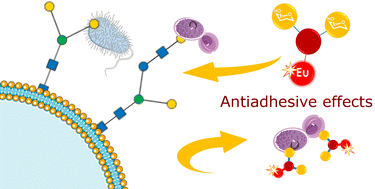
𝗠𝗲𝘁𝗮𝗹 𝗰𝗼𝗺𝗽𝗹𝗲𝘅𝗮𝘁𝗶𝗼𝗻 𝗰𝗮𝗻 𝗺𝗼𝗱𝘂𝗹𝗮𝘁𝗲 𝘁𝗵𝗲 𝗯𝗶𝗼𝗹𝗼𝗴𝗶𝗰𝗮𝗹 𝗮𝗰𝘁𝗶𝘃𝗶𝘁𝘆 𝗼𝗳 𝗴𝗹𝘆𝗰𝗼𝗰𝗼𝗻𝗷𝘂𝗴𝗮𝘁𝗲 𝗹𝗶𝗴𝗮𝗻𝗱𝘀 𝗮𝗴𝗮𝗶𝗻𝘀𝘁 𝗽𝗮𝘁𝗵𝗼𝗴𝗲𝗻𝘀!
Delighted to have another article on glyco-metal complexes published in 𝘖𝘳𝘨𝘢𝘯𝘪𝘤 & 𝘉𝘪𝘰𝘮𝘰𝘭𝘦𝘤𝘶𝘭𝘢𝘳 𝘊𝘩𝘦𝘮𝘪𝘴𝘵𝘳𝘺. This work was led by Karolina Wojtczak, PhD and involved contributions and support from lots of colleagues across disciplines including the teams of Trinidad Velasco-Torrijos, Anne Imberty, Gordon Cooke (TUD), Dr. Cristina Trujillo and Kevin Kavanagh who put lots of work into ideas, assays, measurements and calculations to support our hypotheses.

Please read the full article in the RSC journal Organic and Biomolecular Chemistry, where it will be part of the 2025 New Talent Special Issue: https://doi.org/10.1039/D5OB00970G

Buíochas le Taighde Éireann Research Ireland as ucht tacaíocht.

Thomas & Joe speak at EuChemS-9, Sophie and Hannah present posters

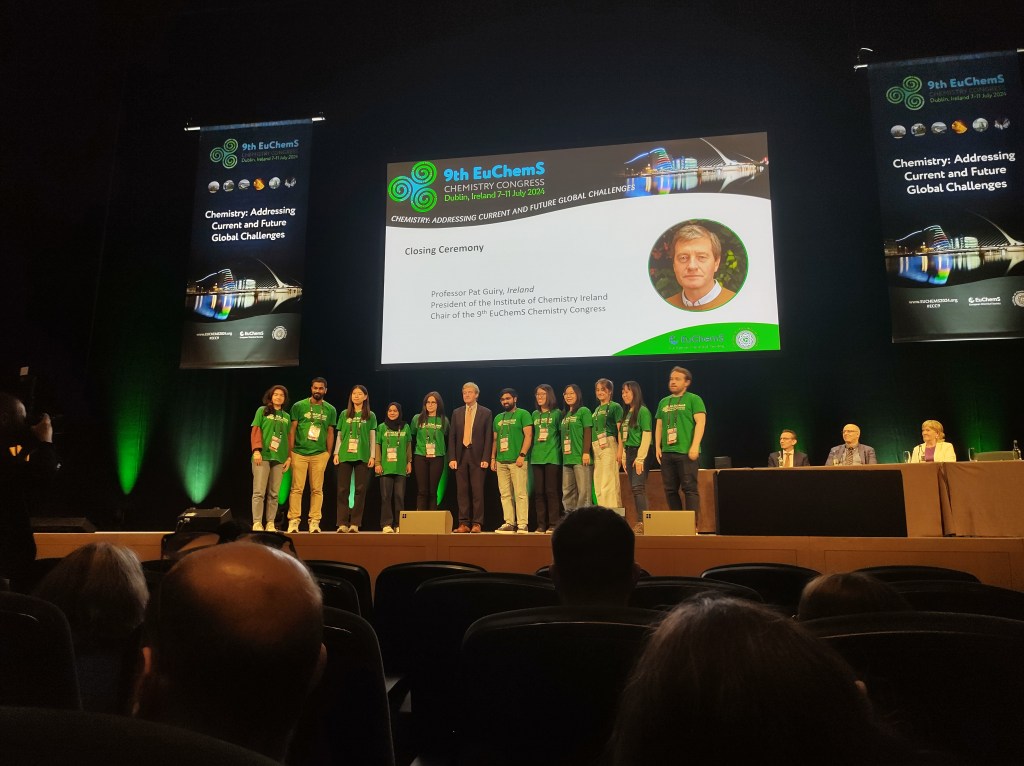
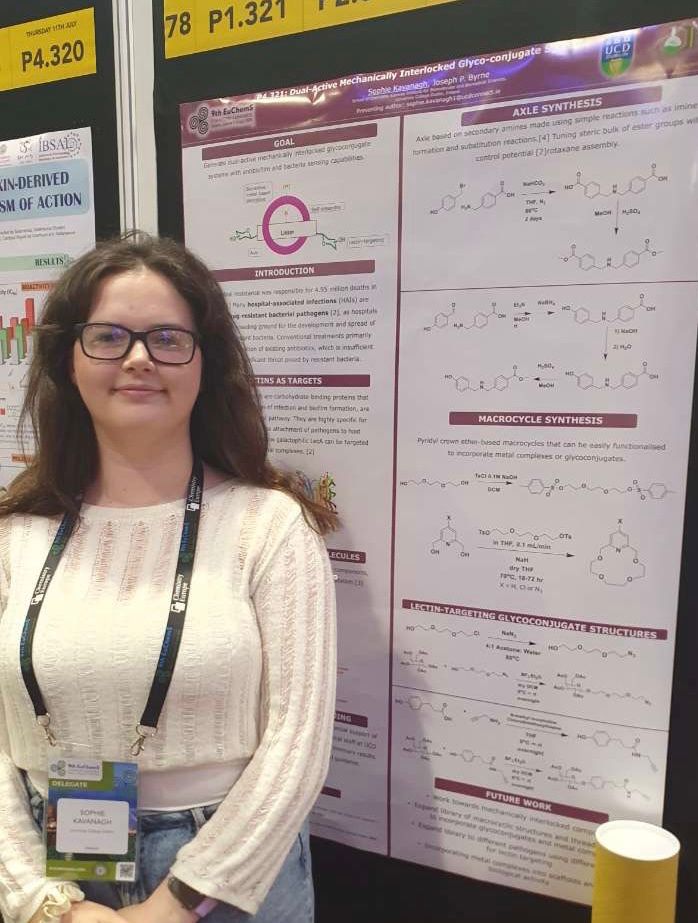
Research from the group was presented in two oral presentations and two poster presentations which featured in the programme of ECC-9, held at Dublin Convention Centre 7-11 July 2024. This major European conference, the largest chemistry event ever held in Ireland, had more than 1500 delegates and a wide international audience.

On the Tuesday, Thomas presented his progress on “Self-templating mechanically interlocked systems as dual activity antimicrobial candidates”, as part of the Link4Lectin project, prompting several interesting discussions with leading supramolecular chemists in attendance. Joe presented “Carbohydrate-functionalised metal complexes: targeting pathogens for therapeutic and sensing applications” as part of the Chemistry Meets Biology for Health Theme on the Thursday.

All of the team attended the meeting, with Sophie and Hannah presenting posters on their work as part of the poster sessions, Wanyujin working as a conference volunteer, and Karolina also joined the conference representing her employer Sterling. Joe judged the posters in the Catalysis theme.

Welcome to our summer students!

This summer we are joined by two visiting students from Arcadia University Study Abroad Programme and one student from Zhejiang Normal University (as part of UCD Chemistry’s ZJNU Summer School). Wanyujin is also back with us as a research assistant on the SugarCoat project. We hope it is a productive exchange for everyone!

Sophie leads student visit as part of CuriosiTY programme

Sophie Kavanagh wrote about her experience hosting TY school students in our lab for some engaging science outreach as part of Systems Biology Ireland’s blog. The CuriosiTY Programme brought postgraduate researchers from the Conway Institute together to take part and introduce students to the world of STEM, and is supported by SFI Discover funding.

The week kicked off with a researcher showcase, allowing each of us researchers to show our journey in STEM, and our current areas of research.
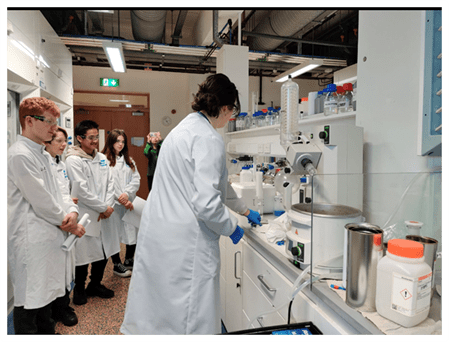
This was followed by some laboratory breakout sessions throughout the week, where I gave 4 small groups of students hands-on experience in the world of chemistry. I decided to centre the lab session around carbon dioxide. 
The sessions began with observing the interaction of dry ice with warm, soapy water, resulting in a flurry of smoky bubbles, full of carbon dioxide.  The extinguishing power of carbon dioxide was demonstrated by placing dry ice in a beaker of water and pouring the dense gas over a lit tea candle, causing it to extinguish, showing some properties of carbon dioxide. 
Next the concept of respiration was explored, linking respiration and carbon dioxide exhalation. I pre-made some lime water for the students to experiment with. The idea here was to send home the message that even though carbon dioxide gas is a colourless, odourless and tasteless gas, we can detect its presence. Each student was given a beaker of lime water with a straw to blow bubbles and observe the colour change from colourless to milky white, and we all had a competition to see who could get their limewater to change colour the quickest.
To wrap up the laboratory session, students engaged in a ‘fire-fighting’ activity. I wanted to show an important use of carbon dioxide, and how to make carbon dioxide balloons at home with some common household items (with adult supervision of course!) Students combined a balloon full of baking soda and a bottle of white vinegar, resulting in a balloon full of carbon dioxide gas. One-by-one, a tea candle was lit and students got to release their carbon dioxide-containing balloons, extinguishing the flames. This hands-on experience allowed students to showcase their inner scientists and left them both excited and knowledgeable.
Each session was concluded with a tour of the lab, and a Q&A session where they asked me questions about chemistry, the Leaving Cert, and what a typical day in my life looks like.

Well done to Sophie for taking the initiative of taking part of this project with UCD Conway Institute.

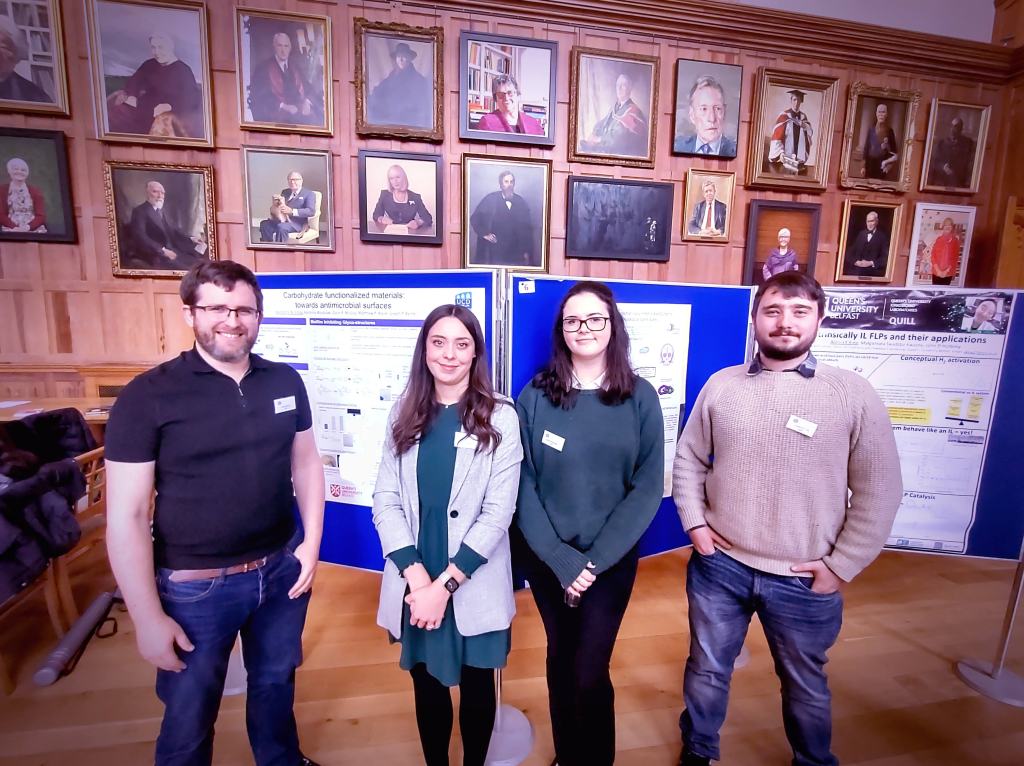
Hannah wins poster prize at ICI Congress

Members of the group attended the Institute of Chemistry of Ireland’s Congress in the Great Hall of Queens University Belfast this week. Two projects were presented as posters: Hannah gave some updates on SugarCoat, while Sophie and Thomas shared a poster highlighting the design of the Link4Lectin IRC Laureate project. Hannah also did an ‘elevator pitch’ for her project and was winner of a poster prize!

It was a very interesting event focussing on sustainability, and also featured the Eva Philbin Award Lecture from our UCD colleague Prof. Susan Quinn.

Joe awarded IRC Laureate Starting Award

Minister Simon Harris recently announced the Irish Research Council’s €24m investment in fundamental research through the Laureate Awards, including a new project, designed by Joe: Link4Lectin – “Mechanically linked molecular strategy for novel antimicrobial agents, pairing bioactive metal complexes with targeting of the carbohydrate-binding proteins of bacteria”. €399,000 have been committed to this project, in which Joe will lead a team of researchers in discovery of new modular antimicrobial tools. This award will allow Joe to establish independence and expand the group as he moves from University of Galway to UCD.

Announcing the awards, Minister Harris said:

“I am delighted to announce the winners of the second round of the Irish Research Council’s Starting and Consolidator Laureate Awards Programme and I congratulate each of the awardees. It is a pleasure to also welcome the Ukrainian researcher who came to Ireland from the war in Ukraine, and who will collaborate on one of the newly funded projects through the IRC’s innovative Ukrainian Researchers Scheme.

These talented researchers will no doubt contribute hugely towards the world-class excellence that is the bedrock of our research system in Ireland, pushing the boundaries of research knowledge and finding new discoveries that deepen our understanding of the world around us, by looking to the past, questioning the present, and unlocking our future potential.”

Also commenting, Dr Louise Callinan, Director of the Irish Research Council, said: 

“The 48 researchers who will receive funding under the Starting and Consolidator Laureate Awards Programme have the potential to make ground-breaking advances in their respective fields and to bolster Ireland’s competitiveness in European research funding.

This is the second round of Laureate funding and many of the first-round awardees will be completing their research next year. It is testament to the success of the programme that three of the first-round awardees have already gone on to receive European Research Council funding, one as part of Ireland’s first ERC Synergy grant worth €10 million.

The winning projects were awarded on the basis solely of excellence, and applications were assessed through a rigorous and independent international peer-review process.

Keep an eye on our Vacancies page for recruitment as part of this award.