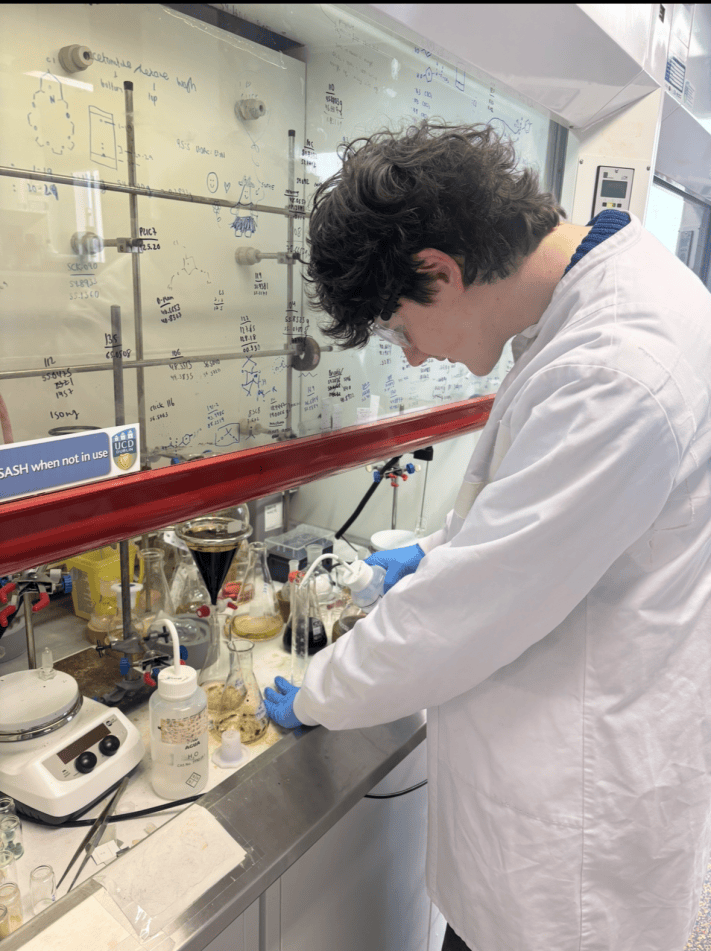
A secondary school transition year student Matthew completed some work experience in our lab as part of his Transition Year programme, under Sophie’s guidance. He undertook several experiments, learned about lab work and got to experience several aspects of UCD student life. Matthew had the following to say:
I spent an amazing three days in the chemistry department at UCD. It was such a great opportunity given to me by a PhD student who not only taught me a lot in the lab, but also showed me around the campus and talked about what it’s like to study chemistry.
During my time in the lab, we carried out two experiments: synthesising paracetamol using 4-aminophenol and acetic anhydride, and decaffeinating tea leaves and coffee beans. Through these experiments, I learned a range of skills, including different filtration techniques (gravity, vacuum, heat, and recrystallisation). I also learned how to use lab equipment like a rotary evaporator and was introduced to separation and purification techniques.
I also got the chance to sit in on an undergraduate chemistry lecture, which really showed me the difference between learning in school and studying at college. Having taken part in a number of TY programmes in colleges around Dublin, this was definitely the best experience. It gave me a real understanding of what it’s like to be a student and what a researcher’s work life is actually like.
–Matthew
Thanks to Matthew’s school and family for facilitating this activity and well done to Sophie on her mentorship.
Sophie Kavanagh wrote about her experience hosting TY school students in our lab for some engaging science outreach as part of Systems Biology Ireland’s blog. The CuriosiTY Programme brought postgraduate researchers from the Conway Institute together to take part and introduce students to the world of STEM, and is supported by SFI Discover funding.
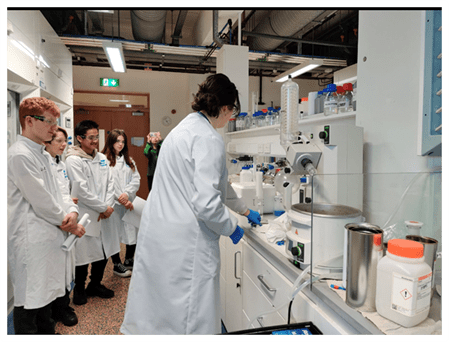
The week kicked off with a researcher showcase, allowing each of us researchers to show our journey in STEM, and our current areas of research. This was followed by some laboratory breakout sessions throughout the week, where I gave 4 small groups of students hands-on experience in the world of chemistry. I decided to centre the lab session around carbon dioxide. The sessions began with observing the interaction of dry ice with warm, soapy water, resulting in a flurry of smoky bubbles, full of carbon dioxide. The extinguishing power of carbon dioxide was demonstrated by placing dry ice in a beaker of water and pouring the dense gas over a lit tea candle, causing it to extinguish, showing some properties of carbon dioxide. Next the concept of respiration was explored, linking respiration and carbon dioxide exhalation. I pre-made some lime water for the students to experiment with. The idea here was to send home the message that even though carbon dioxide gas is a colourless, odourless and tasteless gas, we can detect its presence. Each student was given a beaker of lime water with a straw to blow bubbles and observe the colour change from colourless to milky white, and we all had a competition to see who could get their limewater to change colour the quickest. To wrap up the laboratory session, students engaged in a ‘fire-fighting’ activity. I wanted to show an important use of carbon dioxide, and how to make carbon dioxide balloons at home with some common household items (with adult supervision of course!) Students combined a balloon full of baking soda and a bottle of white vinegar, resulting in a balloon full of carbon dioxide gas. One-by-one, a tea candle was lit and students got to release their carbon dioxide-containing balloons, extinguishing the flames. This hands-on experience allowed students to showcase their inner scientists and left them both excited and knowledgeable. Each session was concluded with a tour of the lab, and a Q&A session where they asked me questions about chemistry, the Leaving Cert, and what a typical day in my life looks like.
Well done to Sophie for taking the initiative of taking part of this project with UCD Conway Institute.